This post is a slightly belated follow up to one from earlier this summer, on the proliferation of cover songs on YouTube. I looked at something I referred to as 'instant nostalgia', or the compressed timeline of close to zero between a) a song becoming popular and b) getting covered in bedrooms and basements and then c) being shot out to the world on YouTube.
This process has allowed some to turn their hobbies into small scale celebrity and to make anywhere from a few bucks to a larger pile of bucks by monetizing views with pre-roll or overlay ads. Such a trend is indicative of what I think of as entertainment without an entertainment industry, the ability to make a creative product and get it out to audiences while bypassing the conventional structures of agents, managers, producers, broadcasters, and distributors.
We've already seen some examples here on the blogof people carving out a path for themselves outside of the bulky industry structures, so in this post I thought we'd take a look at a few people who started out posting quirky videos on YouTube and parlayed their ability to attract attention online into offline attention, like network television appearances, and ultimately to major label recording contracts.
Going back to the spring of 2011 we have one of the model groups in this genre, Karmin, a duo comprised of two Berklee College of Music grads, Nick Noonan and Amy Heidemann. The two combined their musical talents and telegenecity with tagging and search optimization and in very short order found themselves the recipients of millions of YouTube views. Followed by an appearance on Saturday Night Live. Followed by a signing to the Epic label. Followed by chart success on Billboard around the world.
Today Karmin have more than 1.3 million subscribers to their YouTube channel and close to 225 million views. Their cover of Chris Brown's Look at Me Now is their biggest video hit, currently sitting at 85 million views, alongside their covers of songs by Nicki Minaj, LMFAO, and Lil Wayne, that have netted them close to 20 million views each. Perhaps most important is that they've been able to make the leap from what could be thought of as YouTube novelty act to musicians finding success with original compositions. More on the business side of Karmin is covered in this article from Berklee's Music Business Journal, including details such as their licensing arrangements with the NBA and Jay Z's Rocawear and the fact that unlike many new major label signees they were not required to do a '360 deal' in which revenues from ancillary areas such as merchandising, touring, and licensing are also split with the label since revenues from recorded music, the cash cow in the pre-digital days, have fallen so dramatically.
Hailing from Brampton, Ontario, Canada we have the example of Walk Off The Earth, whose early YouTube postings, in true niche-media-looking-at-other-niche-media fashion, were things like covers of songs by The Gregory Brothers, themselves best known for their series of Autotune the News videos on YouTube. First let's take a look at the Gregory Brothers' handiwork...
And now, Walk Off The Earth's take on The Gregory Brothers...
From these humble beginnings the Walk Off The Earth crew morphed into what could be called a 'couch combo' or 'back seat combo', itself rapidly becoming a genre of its own on YouTube. In early 2012 they posted their 1 guitar, multiple hands version of Goyte's Somebody That I Used To Know and things took off from there. 60 million views in 6 weeks, followed by network TV appearances and mainstream press coverage. Their cover of the Gotye hit now has more than 150 million views, and their YouTube channel boasts a total of 350 million views and 1.5 million subscribers. (Note that the Gotye's own version of the song has, by comparison, just over 420 million views; in other words, the cover has attracted more than 1/3 as many views as the original).
Walk Off The Earth have since signed to Columbia, a decision that has left some puzzled. Why, some ask, would people who can pull in these kinds of numbers on their own even want a major label deal? What about the Macklemore model, in which we see an artist retaining higher levels of independence and ownership, with the 'buying in' of additional industry services on an as-needed basis. Evidently, it's not for everyone. And there's nothing wrong with that. Not everyone has the capacity, inclination, or even the interest in navigating the complexities of the business end of things. My hunch -- and if any readers have any additional information on this point, please chime in in the comments section below -- is that an act/artist that comes to the table with demonstrated knowhow and sizable, and often global, audience numbers in hand cuts a more favorable deal for themselves than those who do not possess these attributes (e.g. Karmin brought with them a mailing list of 80,000). As a result we're seeing more options come into being; not religiously do-it-yourself at one end of the spectrum, and sign away your rights to industry at the other end, but instead, greater elasticity and various tiers of possibility.
Anyone who knows me knows that I have had a longstanding interest in the work of an unusual interviewer with the equally unusual name Nardwuar The Human Serviette. Since the late 1980s he's been doing interviews with pop stars, punks, pitchmen, and politicans, first on campus radio and local cable access TV, later as a contributor to MuchMusic (aka Canada's MTV), and most recently on the self-serve smorgasbord that is YouTube. Largely as a result of being able to work around, as opposed to with, broadcasting structures, he has come to be known to a global audience, receiving an unanticipated career bump 20+ years after he first started doing his uncategorizable interviews for the campus radio station at UBC in Vancouver.
Search and ye shall find. Googling as one of the keys to Nardwuar's mid career success
Let's get this party started by directing your attention to this article, which appeared at Slate.com in
Screenshot from recent story on Nardwuar for Slate.com
July 2013. Maybe you came across it; it was pretty heavily shared on Facebook and oft retweeted. The sub-headline says it all -- "Pop music's best interviewer is a very weird Canadian guy on YouTube"-- and I agree wholeheartedly. While almost everyone else in the game has been concerned with things like having the interviewee(s) like them and/or think they're cool, Nardwuar has put all of those concerns aside in favour of the creation of his own category of media encounter. Why do things the orderly, predictable way when you can rewrite the rules and turn the experience into a combination obstacle course/antiques road show of musical history. He's been at it for over 25 years, but it's only since his work has been made available to a broad, global audience on YouTube that things have really been notched up to the next level.
When I read the Slate article I was immediately struck by the extent to which the writer 'got' him, in a way that very few journalists have in the past. Having read dozens of profiles of Nardwuar over the years it soon became clear to me that this was the most insightful one I'd ever read. "Wayward erudition"? Exactly. "His most effective journalistic tools: deep research and pure joy"? A chinwag to that one too. "A kind of creatively sublimated obsessive compulsion"? Yeah, probably true.
Search engines being what they are, I googled the article's writer, Mark O'Connell, and in short order found his Twitter account, and his website, from which I learned he had been doing post-doctoral work in literature at Trinity College Dublin, and was also a journalist who had written for publications ranging from The Observer and The Independent to the New Yorker online. He also penned Epic Fail, an eBook (and it's only two bucks) about this cultural moment's interest in things so bad that they're kind of good. I dropped Mark a line, complimenting him on the acuteness of his observations in the Slate piece, and next thing I knew I was asking him for an interview for the blog. I am happy to report that he agreed and what follows is that Q&A.
Hello Mark, Thank you once again for writing such an incisive article on
Nardwuar, appearing just 1 day before his birthday as well. What a great
gift….at least as good as something he would pull out of his literal bag of
tricks. Here are my questions for you…and feel free to answer in
bullet points, phrases, emoticons…whatever you like. So...what prompted you, a post doctoral researcher in
English literature based in Dublin, to write this article?
Actually, I'm no longer a postdoctoral researcher; my bio on Slate is pretty out of date these days (thank you for reminding me). But I'm a fan of a lot of the music that Nardwuar focuses on in his interviews. I kind of grew up listening to a lot of the people and punk bands that Nardwuar interviewed in the early part of his career. Like Jello Biafra was a pretty monolithic figure in my cultural landscape as a teenager, as were Nardwuar's fellow British Columbians Nomeansno, so I was sort of peripherally aware of Nardwuar for quite a while before I really started watching his videos on YouTube. And I'm quite a big hip-hop fan (although by no means an expert), so I was kind of intrigued to discover, a few years back, that Nardwuar had sort of reinvented himself as this outside figure in the rap scene. And there was something about the dynamic between Nardwuar, who is such a product of US punk culture, and a lot of the rappers he interviews, that I found really interesting. And he keeps improving all the time. I just decided to write about him because I felt like I hadn't seen much appreciation of what he does in the mainstream media. It's also very fun to write about something you're really enthusiastic about for a readership who generally isn't familiar with it. I also felt like he'd had a few great moments recently - like the Questlove interview, and the most recent conversation with Pharrell Williams – so it seemed like as good a time as any to write about him.
My work looks at things that come from outside of industry structures that are able to find a home within new industry structures, so Nardwuar is a textbook case. He started out trying to get noticed by broadcasters and networks but was always relegated to small or unfortunate time slots and generally passed over in favour of the more ‘commercially attractive’ hosts/presenters. What are your thoughts on this new phenomenon we’re seeing – of people who could only have come from outside of industry (no network exec would ever have dreamt up Nardwuar) finding audiences by going direct to fan? (Or is this niche entertainment for a niche audience, that just happens to be global, and accessible via platforms like YouTube, Twitter, and blogs?)
That's a really interesting point, and I'm kind of disappointed now I didn't work that side of things into the article. Nardwuar's always embodied the punk DIY philosophy and the work ethic that goes along with the most successful examples of that; when I think of Jello Biafra's "Don't hate the media, become the media" slogan, it's hard to think of a better example of that in action than Nardwuar. But the extent to which he's benefitted from a structure provided by a massive world-encircling corporation (i.e. Google, which obviously owns YouTube) to faciliate that DIY project is kind of interesting in itself. More power to him, I say. Nardwuar's success and visibility is purely due to the fact that he's incredibly good at what he does, and that people like watching him, not because some network exec decided he should be on TV or whatever, and that's unambiguously a good thing. I don't think he would really work on TV anyway, because the audience would be too broad and scattershot – online, his audience has found him, or he's found his audience, which maybe amounts to the same thing. Yes, I suppose he's pretty much the definition of niche appeal. But who's to say a niche has to be small? (Except maybe the dictionary.)
You use the phrase 'counterintuitively attractive synthesis' to describe Nardwuar’s on air persona. I agree with this characterization…so much in his case is about defying our expectations, and ‘negative charisma’, the tension between the can’t look/can’t not look we all are familiar with from scenes of motor vehicle accidents. Do you think that with the online success of people like Nardwuar, Bryan Stars (www.bryanstars.com), Wade Holland (aka W of www.thechaingame.com), that we may be seeing a shift away from the polished cool of the conventional media personalities and toward something less ‘formed/shaped’? (You use the phrase 'aggressive uncoolness' in your piece in Slate and to me it is precisely that, combined with the swagger and gangsta’ness of people like Snoop, Waka Flaka Flame, Juicy J, L’il Wayne that makes it work. When Nardwuar did his first interview with Snoop in 2000 I told him that if he was in the US he would probably get shot for trying to do interviews like that one. How wrong I was.)
I'm not sure, really. I guess I'd be sort of reluctant to see Nardwuar as indicative of anything other than himself, because he seems to me to be such a unique figure. He's a one-off; it's easy to imagine people being inspired by him, but difficult to imagine anyone else doing what he does. There's definitely an element of the 'negative charisma' you mention in some of the more awkward of his interviews – usually from early on in his career. But, for me at least, the appeal of Nardwuar is almost purely in how incredibly well informed he is on his subjects – but look who I'm talkting to here! – and in the contrast between his awkward geeky persona and the people he's talking to. That's really interesting that you said that to him about the Snoop Interview, given what a turning point that seems to have been for him. But who could have predicted that turn? To me there’s a grand irony in the fact that the job of broadcasters and networks is to pair up talent and content with audiences. And what we have, and poetically so in the case of Nardwuar, is a person for whom the removal of the broadcasters, not their blessing, was the key to reaching a critical mass. Any theories on the changes we’re seeing in what people actually want to see on platforms like YouTube, and what broadcasters/network executives think people want to see?
This isn't so much a theory as maybe a restatement of what you've just pointed out, but yes, it seems to me that Nardwuar is a prime example of a situation where the removal of gatekeepers has worked out well for the relationship between talent/content and audience. But at the same time, it was gratifying to see how many people reacted to the Slate piece by saying that it was their first exposure to him, and that they'd instantly become obsessed with watching as many of his videos as possible.
You told me in an earlier email that your early exposure to Nardwuar was probably pre-YouTube, going back to the days of zines and DVDs (or maybe even VHS tapes?) In those days he tended to focus on punk, garage, and 60s-inspired bands, whereas his recent ascent can be directly correlated to the way he clicks with rappers/hip hop artists. Why do you think artists from this genre resonate so well with the Nard-world?
Actually, I was thinking about this quite a lot while I was working my way through the highlights of Nardwuar's career for the piece. I think maybe part of it has to do with the fact that the kind of person Nardwuar is would be much less familiar to the rap interviewees than to the punk bands he started out interviewing. So there's that frisson of, I don't know, otherness, that adds an interesting tension to the set-up. But I also thought – and this could be completely, utterly wrong – that maybe the reason Nardwuar clicks so well with a lot of the hip-hop people he interviews is that so many rappers and people involved in hip-hop are so well-versed (no pun intended), so completely saturated, in rap history, that they're particularly well positioned to appreciate the depth of his knowledge. The whole culture of crate-digging, of being a scholar of the history of the music, seems to be quite central to hip-hop. The interview with Questlove was a really strong example of that for me. Because it didn't seem like a conventional popstar/interviewer dynamic so much as two music historians having this joyful exchange of their knowledge. Thanks to Mark O'Connell for writing the piece in Slate and for doing this interview. And thanks to Eclectic Method for this 2 minute crash course mashup of Nardwuar interview moments:
Success is hard to judge ahead of time, and definitely not guaranteed.
These are the words of Princeton economist Alan B. Krueger who is also Chairman of President Obama's Council of Economic Advisers and who recently delivered this speech, using the troubles of the music industry in a time of digital disintermediation as an analogy for the disappearing middle class in the U.S.
The music business has traditionally been what is called a hit-driven business, an industry in which a few players make a lot, as in really a lot, and most of the rest make a little, and are then removed, either by the gatekeepers, or by themselves, from the system. The entertainment industry is one of the most notorious of the hit-driven businesses, with success rates for movie studios, music labels, and book publishers being in the low single digits. In other words, failure rates of 90% and higher are the norm. But, when something hits, it hits not just big, but big enough to make up for the losses of the rest of the roster.
These industries are also sometimes referred to as a 'winner takes all' markets, though if you want to get picky about semantics they're really 'winner takes most' markets. The illustration below provides a basic visual of how the economics of most sectors of the entertainment industry function.
In the conventional industry structure odds were high, but the gargantuan payouts that happened maybe 5% or so of the time made the economics work. The blue portion on the left in the drawing above represents the small percentage of artists who sold enough of their work to maintain a relationship with their publisher -- this could be a record/music label, a publisher of physical books, or a movie studio. Approximately half of the blue section represents artists that are profitable. The other half of the blue curve represents artists that are breaking even, and the section in yellow represents the 80 or so percent that fail to find a big enough audience with which to justify their participation in a mass market structure such as the music, film, and book industries of the latter part of the 20th century.
If, as an artist working within the industrial structure of major labels or publishers, you found yourself in the section of the curve that was blue, but just barely...as in, you were almost in the yellow, this generally meant that a significant sales bump notwithstanding, you were probably about to get dropped. The cost of carrying something that wasn't moving significant amounts was simply not feasible in the model in which the mass market, the mass audience, and mass marketing were the holy trinity of operating.
Then, at the dawn of the 21st century along came Chris Anderson and his theory of the long tail, made famous in an article he wrote for Wired Magazine in 2004 and later by a book of the same name. "Forget squeezing millions from a few megahits at the top of the charts", said Anderson. "The future of entertainment is in the millions of niche markets at the shallow end of the bitstream." Anderson's point was that in the digital marketplace the yellow part of the curve in our handy diagram above was not a no man's land, but in fact, a deep treasure trove which could efficiently serve a diverse and diversified public. Concepts such as shelf space and incremental marketing costs were rendered almost irrelevant in the digital world, paving the way for that long, yellow tail we see in the illustration. Lots of choice, lots of genres, and creations that don't necessarily need to satisfy the tastes of the masses in order to be economically viable.
What a switch this way of thinking was. Just a few years earlier if you were relegated to the yellow portion of the diagram's curve you had few options for remaining in the game. As cultural and media theorist John Hartley put it, "...the long tail felt like powerlessness." And the reason it felt that way was because of the lack of connectedness between people in the yellow part of the diagram. The people in the blue curve were the mass audience, generally well-served by the mechanisms of mainstream industry, but the people in the yellow part of the curve, with their niche or non-mainstream tastes, were very limited in their ability to tell others about their discoveries, to find others that shared their interests, or to communicate directly with the cultural producers. And so, that which was unpopular remained unpopular, and that which was popular tended to get more popular.
Now, to return to the man responsible for the opening quote of this blog post, economist Alan Krueger. He takes a distinctly non-Andersonian view of both the music industry and the U.S. economy. A few weeks ago Krueger delivered a speech at the Rock & Roll Hall of Fame that used the fate of the music industry over the past dozen years to explain the erosion of America's middle class. And yes, it is true that in the case of the music industry we have seen the evaporation of half of its value as a result of the onset of the digital era of music. This is due to the fact that it became possible to freely exchange audio files online, the basic unit of consumption changed from the album to the single, and streaming on-demand music services such as Pandora, Spotify, and Grooveshark put every piece of music we could ever want at our fingertips, either for free, or for a nominal monthly fee.
But it is also true that we now have the category of working- musician-you-probably-haven't-heard-of, new revenue streams for artists big and small, and access to marketing techniques that require neither big dollars nor big teams.
For his recent talk, entitled “Rock and Roll, Economics, and Rebuilding the Middle Class", Krueger updated the music industry revenue data underlying his pioneering work in rockonomics. These papers, first published in 2004 and 2005, showed, systematically, how the rich get richer in the music industry, which he suggests is also happening in the U.S. economy in general. So much for the American dream, whether in life in general or rock and roll aspirations. Krueger uses concert revenues as his data set, and demonstrates how the top 1% pocketed over 50% of concert revenues in 2003, versus the top 1% claiming approximately half that amount 20 years earlier.
Krueger's rationale for using the concert business to illustrate ongoing problems with the U.S. economy:
The music industry is a microcosm of what is happening in the U.S. economy at large. We are increasingly becoming a “winner-take-all economy,” a phenomenon that the music industry has long experienced. Over recent decades, technological change, globalization and an erosion of the institutions and practices that support shared prosperity in the U.S. have put the middle class under increasing stress. The lucky and the talented – and it is often hard to tell the difference – have been doing better and better, while the vast majority has struggled to keep up.
I shared the link to Krueger's paper with my colleague Aaron, a fellow digital media researcher. He came back to me with some very thoughtful observations. I'm including Aaron's comments here, with his permission. He wrote:
"Curious as to why the music industry was chosen as a microcosm of the U.S. economy and not others? Do the same principles apply in other industries? The luck / talent combo is really key. If you believe that financial success is mostly the latter, why shouldn't we be a winner take all economy? After all, it's only fair to reward those with talent who work hard. But I think research shows that the luck factor is stronger than most people think. You're lucky where you're born, who raises you, what opportunities you have, etc. Even CEOs don't really matter that much in terms of firm performance.So, as you know, many, many amazing musicians don't know how to take advantage of digital technologies / reach an audience. It's not as simple as putting your music online - you need skill as an artist, skill as a brand manager, and also a lot of luck that you find the right people and vice-versa... right, right?
So how do we think about the likes of YouTube and Facebook as gatekeepers? Do their algorithms (YouTube recommended videos / EdgeRank, for example) help musicians get lucky by giving them exposure; or do they just help already popular musicians get more popular?
I think in the music industry, just as in the U.S. economy, there is the perception that those who 'make it' do so strictly out of talent / desire / hard work - when really there are all sorts of underlying forces (driven by influences from algorithms, peer communities, broadcast media, etc) that when serendipitously aligned correctly, improve your chances of success."
What do you think? I would love to hear any comments or theories you have on the topic; are long tails translating to viable niche markets for you? Or have the lowered barriers to entry done little more than created a logjam at the supply end of things? As politicians like to say, are you better or worse off than you were four years ago, or in this case 10-ish years ago. I have reason to believe that at least some of you reading this blog either currently are, or have been, in the creative industries, so your firsthand experiences would be a valuable addition to the discussion.
And there it is in my Facebook feed, and in the paid ads on the right hand side of the page. Ads for a new movie being pitched by comedian Adam Carolla. I'm being invited to be a backer of the project.
But I'm not special...you can be a backer too. Anyone can. Carolla is perhaps best known for The Man Show and for his 10-year stint co-hosting the syndicated radio show Loveline with Dr. Drew. He then went on to land his own syndicated radio show, carried by CBS Radio. When that high profile gig got cancelled in 2009, rather than look for another radio job in the traditional industry, he immediately started podcasting, not missing a single day on the air. From day one Carolla's podcast has been receiving well over a million downloads per week and even broke a Guinness Record in 2011 for being the world's most downloaded podcast. But Carolla, ever the self-deprecator says he's always just "3 podcasts away from failure."
Nonetheless, I clicked through on the ad that had popped up on Facebook to find about more about Carolla's project and got this screen:
Of course it occurred to me that Carolla doesn't 'need' the money. He has a reported net worth of approximately $15 million, owns multiple homes, and even has a collection of exotic vehicles. And then I started thinking about the shift occurring on crowdfunding sites. In the early days the lion's share of projects were humble, cottage-industry type projects. Kind of the Etsy of media production, with modest asks in the low tens of thousands of dollars, and from people who really needed the capital in order to pay for things like studio time, musicians, artists, and designers. A short few years later and now people with the funds to underwrite their own projects are also turning to the crowd for financial support. The ones that come to mind are high profile Hollywood types such as Zach Braff, who recently raised $3.1 million for an upcoming film project, and the team behind the feature based on the defunct television show Veronica Mars, who pulled together $5.7 million in public backing for the project.
In an earlier post I looked at some of the stats for the most popular crowdfunding site, Kickstarter, and we saw that while some projects bring in millions, the majority bring in $10,000 or less. That's a level of funding that is easier for us to make sense of. Where it gets counterintuitive in when those doing the asking are themselves those people are established, if not wealthy, entertainment industry insiders. Yet the donations continue. So what is going on here? Why is the public participating? For the smaller projects by do-it-yourself filmmakers, musicians, and producers the phenomenon is at least a little understandable (though, frankly, I would have never imagined it would succeed at the level it has). Contributions to projects aren't even tax-deductible, many of the projects are not completed (hence the arrival of laws pertaining to crowdfunding), and the incentives offered to project backers have been referred to as 'laughable'.
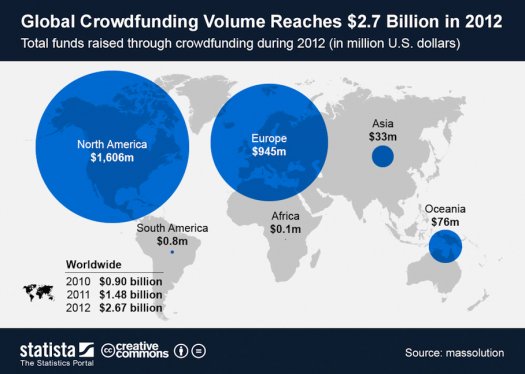
And yet, crowdfunding as an activity has tripled in the past three years, and is now a billion dollar business in North America and Europe.
So what does this populist philanthropy provide us with? And why do people keep on pledging, and do so with even more zeal when it's for a project spearheaded by a celebrity? It seems to me that what we are seeing things that were once the function of private and public sector institutions being shifted to the public at large. Projects, big or small, risky propositions or not, now have funding options outside of business, government, and family and friends...and industrial structures. And to take things one step further, when industry makes its investments in creative projects it has the chance, albeit slim, of making a return on the investment, whereas when the public opens its wallets, this is currently not the case or the expectation. I say currently because in the US, at least, the SEC is in the process of creating rules and requirements for equity crowdfunders.
One way to think about this phenomenon is through the framework of what most of us were previously prevented from doing, i.e. activities such as media production and investment. That was the domain of a privileged elite. Now most of us do a version of these things every day, via our participation on Twitter, Instagram, Yelp, TripAdvisor, Facebook, YouTube, SoundCloud, and the like. We have gone from being excluded from the economies of information and production to being radically included in them. And based on the billions of tweets, status updates, and sound and image files we post daily we seem to prefer the inclusion over the exclusion. We are more than willing to exchange actual currency for social currency and cultural currency and in the process we are reconfiguring the nature of those increasingly amorphous things, the media and entertainment industries.
In the nascent days of crowdfunding a common rationale provided for public donations to people's creative projects was that it was a manifestation of the gift economy, moved to the the digital world. I would argue that earlier on, when projects were small and had a definite cottage industry feel to them, that this was the case. I know that I put a few payments through in those days and that's definitely what it felt like. I was happy to 'gift' a small amount to someone whose work I admired, someone who I was pretty sure could not do their project otherwise, and my expectation in return was nothing more than the pleasure of seeing the work completed. But things have changed since then. For one thing Kickstarter fatigue has kicked in for me. It's no longer a novelty when dozens of people you know are hitting you up for dollars for their short films, albums, and performance art projects. And the larger question, which is the topic of this blog post, is: why are people donating funds to those who, unlike most of those in our personal circles, don't really need the money?
The answer may be found in the quasi-political action that crowdfunding has become; a way for large groups of people who don't know each other to band together and effectively buck the system. It is a way for ordinary people to simultaneously cast their vote for the person and against the industry which may have once supported that person. In the case of an Adam Carolla movie those making financial contributions know that by supporting Adam directly the project can get completed without studio or producer interference, and that's the kind of Adam Carolla project they prefer to see. "The man", in such cases, is the movie studio, or the music label, or any other sort of gatekeeper that holds reins of power and has rules attached to its cash. The crowd, however, works outside the system.
While our knee-jerk reaction is to think of celebrities hitting up common folk for financial support as somehow sullying the system, the unexpected result is that as the base of contributors becomes even larger, there could be more to go around for everyone. It's the argument that says a bigger overall pie provides more pieces for everyone, even if some of those pieces are small. So when Adam Carolla or Zach Braff look to the people of the Internet for financial support for their projects, the overall base of contributors becomes much larger than it otherwise would have been, and the practice of crowdfunding moves from marginal to more mainstream activity. While it is too soon to say if this is a blip in time or something that will have a long-term effect on the way creative production is done, for now this blog watches with great interest as the principles of DIY/do-it-yourself production are applied across large swaths of the landscape and an entire industry develops around it.
The last couple of blog posts have looked at the phenomenon of cover songs on YouTube. And we're not talking about parody type cover songs -- that's something for a future post perhaps -- we're talking primarily about faithful renditions of well-known songs, by everyone ranging from kids in their bedrooms to musical hopefuls of all ages...and skill levels. More than 10,000 such videos are uploaded to YouTube every day, representing probably hundreds of millions of views monthly, and possibly more.
There are a few really interesting things about this phenomenon. One is the speed with which these cover songs appear. Often within days of a song being released various versions begin popping up online. To wit, there are already several pages of versions of the summer of 2013 fave Blurred Lines (currently at 65 million views). I randomly clicked on the one below, with just 100,000 views in the 3 1/2 weeks since it was posted and I must say it's pretty great. (It even includes a homage to the proto-rap shizzle scatting ofDouble Dutch Bus.)
My bet is that earlier in the YouTube timeline a version like this would have pulled in way more traffic than 30,000 views per week as it possesses a high shareability quotient (fun, current, imaginative) and the act of circulating it builds the social capital of the sender...those key ingredients people at marketing conferences always cite. (Ed. Note: Were it that simple).
And so what we are witnessing is the lag time from release to interpretation reduced to almost zero. This is a great example of what writer/cultural commentator Douglas Rushkoff refers to as "presentism" in his latest book Present Shock, though Rushkoff frames it as more problematic than it may actually be. In the context of cultural expression, at least, such presentism has created a vibrancy and volume of output that is unprecedented. With the filtering and distribution done by anyone with a phone or laptop we get a good glimpse of the workings of "entertainment without an entertainment industry", the very theme and inspiration for this blog.
Another thing worthy of note about many of these covers is the level of originality often found. And I know what you're thinking...she just said 'cover' and 'originality' in the same sentence. And that's the point. Twas not always thus. I would argue that as the cover song migrated from being a marketing tool of the music industry to something whose execution was broadly dispersed throughout the civilian population - and publishable via platforms such as SoundCloud and YouTube - that covers have become more imaginative and more individualistic; no longer a genre so often framed as being the domain of the lazy and uninspired. (Ed Note: For those really really interested in the evolution and role of cover songs in popular music from the mid 20th century to now, see the 2010 collection of essays edited by George Plasketes entitled Play It Again: Cover Songs in Popular Music).
One of the first groups I remember posting more artistic kinds of covers to YouTube was Pomplamoose, the Northern California duo of Jack Conte and Nataly Dawn. They started posting and selling digital songs on their website in the spring of 2009, and shortly thereafter landed a spot on the YouTube home page. This led to much linking and sharing -- and eventually sales of 100,000 downloads that year, enough to make a living as they operate without a label, manager, or staff. Their YouTube homepage now lists a booking agent and a licensing agent but it appears that Jack and Nataly handle the rest of their affairs themselves. This sale of 100,000 digital downloads was, then, enough to create the foundation for an independently helmed and managed career in music, including a a series of Hyundai commercials during the 2010 holiday season, a Toyota commercial, and only a minimal amount of touring. In addition to their work as Pomplamoose both Jack and Nataly have solo careers, with songs available for purchase viaYouTube, Amazon, the iTunes store, and their websites.
Earlier this year Jack Conte launched Patreon, an alternative to Kickstarter for supporting creative
projects as he believes that
Pomplamoose's YouTube success is not repeatable and is looking to create new ways for music to be a viable career path. In other words, Conte is saying that what worked for Pomplamoose probably won't work for you, which is laudably honest of him. One of my biggest pet peeves when it comes to digital platforms is that many try to put forward 'best practices', or edicts, that suggest if you take actions A, B, and C then you will get result D. And while in the analog world this may have been possible to a certain degree, it's much less likely in the digital domain, as content floods in at an unprecedented pace by the minute (let alone hour, day, and week), platforms and preferences change at breakneck speed, therefore standing out and gaining a substantial following is more challenging than ever. The good news is that such an environment of rapid change and flux creates what Jack Conte refers to as 'momentary opportunities', or a wealth of things to try, at relatively low costs, and what works, works, and what doesn't gets put aside. (For more on this topic see a very candid and reflective interview with Jack Conte here).
And now, here is Pomplamoose's take on Beyonce's Single Ladies, complete with ethereal vocals and jazzy chord subsitutions...some might say wholesome hipsters able to make mainstream songs sound indie. This video has been viewed ~10 million times and Pomplamoose's YouTube channel has amassed 365,000 subscribers and a total of 88.5 million views (as of late June 2013).
And there are others who use the vehicle of the YouTube cover to promote adjacent aspects of their creative lives, such as jazz pianist, arranger, and composer Scott Bradlee. Some highlights from his bio:
Provider of elegant piano music for hundreds of weddings, cocktail hours, private parties, and cabarets
Has collaborated with a number of Broadway and off-Broadway performers and writers
If it's well-played, genre-straddling cover songs you're after, then this is the YouTube channel for you. You'll find everything from a country version of Ke$ha, a 1920s version of Psy, and even a Les Mis/Aerosmith mashup, entitled I Dreamed a Dream On. Most of the videos on Scott's YouTube channel have a few hundred thousand views, with one or two in the low millions, and a good portion in the tens of thousands of views. His YouTube channel has a total of ~8 million views and is currently growing at a rate of ~50,000 views per day/1.5 million views per month. Scott is not making a living on YouTube alone, particularly with all the musicians and performers involved, but he has taken something that is usually costs money to do, i.e. marketing and promotion, and has turned into a source of revenue.
"Before things took off on YouTube, I was a jazz pianist," says Bradlee. "When I moved to New York when I was 24, I did the thing all musicians do, played clubs and so on. I had all these ideas in my head since high school, like when would I take classic rock and made it ragtime. I was probably the only kid in my high school who really liked ragtime. I wanted to find a venue for that kind of experience. I didn't find it in jazz clubs—I found it on YouTube."
Coming up in Part 2 of this post: a look at a group that went from a highly trafficked YouTube channel to a major label deal, another that landed a spot on SNL, and in future posts we'll also look at some of the legal/copyright implications of posting and monetizing cover songs online.
Just a quick post to commemorate hitting 10,000 page views here on the blog. The management and staff at demassed.blogspot.com have been working hard to provide you with interesting and insightful content since launching in late February 2013 and would like to take this opportunity to thank you graciously for your patronage.
This said, I think I can stop counting page views now. I was so taken by the rate of growth on the blog early on (expectations were low to modest; it must be a self-protective thing) that each time a milestone of another 1,000 page views was reached I sent out celebratory tweets. I think I will not burden you with such gloat-tweets after this one. I would just like to say thanks for the page views, the thumbs up, the retweets, and your overall interest in the project. I'm not sure if/what it will turn into, beyond a blog, but as this highly numerical world in which we live provides me with feedback regarding the posts, I am considering the possibility of expanding it to something more substantial.
I have been travelling lately and will be doing a relocation for a chunk of the summer for a research project I'll be working on, so blogging may be more intermittent than it has been, but rest assured that I have a few posts in progress and plan on getting them up in short order. I also tweet individual stories related to the topic of digital disintermediation, and you can follow them here, in the window on the right hand side of the blog, or you can tw-ollow me directly @LK617.
Once again, thanks for your blog support and feel free to drop me a line with comments, suggestions, or any manner of feedback re the topics covered here.
Hello again, and welcome to this blog's first feature interview.
In just a few minutes we'll be meeting a 9 year old kid from Colorado who goes by the name JD Violin Boy (because, among other instruments, he plays the violin). I wrote about JD last week in my blog post on cover songs on YouTube, after discovering JD's version of Macklemore's 'Thrift Shop' that featured the young boy's vocals atop his violin loops and keyboard playing.(Ed. Note 1: As readers of this blog may already know I got a bit caught up in the story of Seattle hip hop sensation Macklemore's ascent to stardom, and ended up doing a 7-part series on it here on the blog.)
I then noticed that JD had been regularly posting videos to his channel for two years, since he was just 7 years old. He has almost 100 videos in total, in which he plays ukelele, piano, and/or violin and sings popular songs by current artists and bands such as The Lumineers, Vampire Weekend, and Bruno Mars. JD loves Bruno Mars, having covered eight of his songs, and one of those covers was even tweeted by Bruno himself. JD's most popular cover of a Bruno tune is now approaching 2 million views. JD is one of a new breed of performers who, without the involvement of broadcasters, agents, or managers, is able to ply his craft -- in his case from the comfort of his bedroom and living room -- and have his work reach a relatively small but global audience. And as he does so he gets better and better at what he does...and also earns a few bucks. In the interview below we'll meet other kids from JD's cohort, a kind of brotherhood and sisterhood of musical youth who seem way more talented than any of us older folks were at that age. Sampling all of these talented kids singing and playing their hearts out makes me wonder if the world is going all American Idol Jr., or if this is more about the ease with which performances such as these can now be recorded and distributed. Yes, some of this posse of YouTubing kids may well become the Justin Timberlakes of tomorrow, others will likely be really good entertainers at office parties, and who knows, perhaps we now have a third category in which a small but sustainable career can be carved out making videos such as the ones you'll hear about and see below.
I got in touch with JD Violin Boy on Twitter and was impressed with how articulate he was (even in 140 characters) so I thought why not break out beyond the few words we can exchange via tweets and see if he might agree to a longer form interview via email. Happily he did.
One other thing I should explain before you dive into the interview is the significance of the company Fullscreen, that I talk about with JD below. Fullscreen is a YouTube partner network. This means it is a company that selects videos from the huge pool of people that post them on YouTube, and aggregates them in one place. By doing this Fullscreen acts as a kind of quality filter, for both viewers and advertisers.
But perhaps the real genius of Fullscreen is the deal it recently struck with Universal Music, the largest holder of music copyrights in the world. Up until this deal was struck, covering songs on YouTube was technically illegal. By negotiating this deal Fullscreen and Universal have been able to move the activity of covering songs on YouTube from the category of illegal and subject to a takedown notice to legal and monetizable. Once everything is legal, ads can be featured in the pre-roll of the video, or as an overlay, and the proceeds can be split between Fullscreen, Universal Music, and people like JD Violin Boy. A bit of the taming of the wild west that is the Internet that prevents superfluous copyright lawsuits and makes it possible for writers and performers to get paid.
(Ed. Note 2: FullScreen's function is an example of what I see as a re-intermediation, or involvement of third parties that mediate the process between video producers like JD Violin Boy and audiences, in this case anyone who watches YouTube. This act of re-intermediation is a topic I will explore in greater detail in future blog posts as it's illustrative of the new types of industry forces that have emerged in a media landscape of abundant, or some would say overabundant, content. There are a number of players fulfilling this function and I plan on examining them here in the coming months.)
And now, here is my interview with YouTuber JD Violin Boy:
Me: As you are just 9 years old did you have to get your parents' permission to do this interview?
JD: Yes.
Me: In your videos I see you in different rooms of your house....how many set-ups do you have at home with the keyboard and microphone, or do you move things around?
JD: My dad moves stuff around.
Me: I think I see a bunk bed in the background of your room...do you share your room with a brother or sister?
JD in his room, which is all his.
JD: The bunk bed is just for me. Nobody ever sleeps in the top bunk. I have a sister. Unfortunately, she is not very musical. She tried piano, clarinet, and drums, but nothing worked out.
Me: You started posting your videos to YouTube 2 years ago, when you were just 7. Whose idea was that?
JD: I don't remember whose idea it was. At first, we just wanted to share videos with friends and family. Then some of my early Bruno Mars covers got a lot of views and we started to get more serious about it.
Me: There's also a video of you on your channel at age 4, singing 80s songs on a karaoke machine. When you look at that video what do you think of your performance? How do you think you've changed since then?
JD: I always give my all when I sing and, watching that video, I think that was true even when I was 4. My voice is a bit different now and I play all kinds of instruments.
Me: In some videos we see your foot & looping pedal in a little box in the video, or in the Everly Brothers video we see 3 of you, harmonizing with yourself. Do you have help with the video recording and editing or do you everything yourself?
JD: My dad does all that. He is teaching me how to do it myself. I have begun using GarageBand and am getting pretty good at it. We are going to learn Logic Pro next.
Me: How many hours per week would you say you spend working on your YouTube channel? Does this ever get in the way of homework or other things you have to do?
JD: It takes maybe 3 or 4 hours per week. That's in addition to time I spend practicing my instruments. I don't have much homework, so it's usually not a problem.
Me: You have around 5 million views on your channel, of which about 2 million are for one of your Bruno Mars covers. And he tweeted it! How did that happen? (I saw your "oh my gosh oh my gosh Bruno tweeted my video" video...but it didn't say how it happened. So...how did that happen?
JD: Bruno Mars tweeted my cover of "It Will Rain", which has about 600,000 views. I have no idea how it happened. As you can see from my video, it was a complete surprise to me!
Me: There's also a video of you on stage with Imagine Dragons, whose songs you have covered. How did that happen?
JD: I entered their cover contest for "It's Time" and won. My parents followed up and were able to get in touch with the Imagine Dragons band manager. One thing led to another and the next thing I knew, I was up on stage with the band. What an incredible night!
Me: Do you have an agent and/or manager?
JD: No. For YouTube artists, there is no need for that.
Me: You are part of the FullScreen network on YouTube. Did they approach you or did you approach them? If the former, how did they find you? What did your parents say when that happened?
JD: They approached me. I have no idea how I came to their attention. My parents encouraged me to sign and we are happy with it.
Me: Without asking you how much money you make on YouTube (you can tell me if you'd like to, but don't have to) are you happy with what you're making? Are other kids at school envious of you....because you have your own YouTube channel *and* you're now getting paid?
JD: I don't pay any attention to that. Actually, I have no idea how much money I'm making.
Me: Do you spend the money on things like upgrading your gear and/or instruments?
JD: No, my parents pay for all that stuff. (Thanks, mom and dad!)
Me: Because the amount of money you make is based on how many views you get what have you concluded about why some videos get more views than others? (How closely do you watch the number of views, or are you just trying to have fun and to get better at what you do?)
JD: I keep an eye on page views to see what people like, but for me the most important thing is to have fun and express myself musically.
Me: Do you know any/many other YouTubers (people with their own channels) like yourself...kids making videos on their channels?
JD: Yes, I got to collaborate with Ryan and Emily, two of the most talented kid drummers on YouTube. I admire them so much.
Drumming Emily has 17 videos up on YouTube and over 613,000 views
Singer Jasmine Clark has posted 53 videos on YouTube and has 3.5 million views
Jasmine Thompson has written one of the most beautiful songs I've ever heard ("Just in Time for Tea"). I think she pulled it from YouTube. I hope she will release it again soon.
Me: Are there any YouTubers in particular that you look up to, or follow? (e.g. Greyson Chance...was he an inspiration to you?)
JD: I follow hundreds of people and bands on YouTube. In addition to Ryan, Emily, and the two Jasmines, I look up to Bryson Andres and Daniel Park. They inspired me to start using a loop pedal.
I also look up to Roomie. He is a singer and multi-instrumentalist who does covers and has also written some great original songs. His videos are creative and he has a great sense of humor. My goal is to make my videos look as good as his.
Sweden's Roomie has 46 videos on YouTube and is closing in on 7 million views
Another one I like is Walk Off the Earth. They are signed to a label now, but they got their start on YouTube and still do covers. My favorite YouTuber, though, is Miranda Sings. She is "beautiful" and has "great" vibrato!
I know who Greyson Chance is. He got on Ellen's show and hit it big, but that's not really something most YouTubers can do. Look at Roomie, Walk Off the Earth, and Miranda Sings. These are people who worked hard, day in and day out, to build a big YouTube following. That's what I am trying to do.
Me: Do kids at school or other friends suggest songs for you to cover, or is everything your idea?
JD: I try to cover new songs, because that's what most people like to watch and hear. The kids at my school are a little out of date. Some of them are just discovering "Gangnam Style."
Me: Do you find the sheet music online or do you sometimes sound things out by ear?
JD: I used to use sheet music, but now I play everything by ear.
Me: How many takes do you generally do before you're happy with the video? I ask because I like the way you leave in things like the page flip, as you did in your Adele/Rolling in the Deep video. (Some people might have edited around that but you didn't and that's cool).
JD: On average, about 2 takes. Sometimes more. Take a look at the end of this video.
Me: Have you been contacted by any TV shows?
JD: An NBC show, "The Voice Kids", contacted me but my parents and I decided against it. I don't feel like that's the way to go for me. Things are going well on YouTube. Spending a lot of time competing on a TV show would slow me down.
Me: Are there any shows you'd really like to be on?
JD: I don't spend much time thinking about TV. I just try to do the best I can on YouTube.
Me: Ellen DeGeneres seems to specialize in having kids from YouTube on her show...has her show been in touch with you?
JD: No. It's flattering when my commenters say I should go on Ellen's show, but I realize that's not very realistic so I don't focus on it.
Me: You also do live performances around where you live....how long of a set do you do? How much of a celebrity are you locally? (for example, do you ever get recognized on the street?)
JD: My set is half an hour. Someone recognized me at an Imagine Dragons concert a few weeks ago. Other than that, I've never been recognized.
Me: Do you have help with things like uploading the videos, responding to comments and fan mail, etc....or do you do all of that by yourself?
JD: Yes, my dad helps me with all that.
Me: You seem to like to wear different hats in your videos. Do you wear hats a lot off camera or just in the videos? What is the story behind the tartan hat you wear in the video for "When I was Your Man" by Bruno Mars?
JD: Bruno Mars is one of my musical role models. Not only because he is a great singer and dancer (I like to dance too), but because he writes amazing songs. He wears hats sometimes, so I do too. There is no special story about the hat I wore in my "When I Was Your Man" cover. I liked it so my parents got it for me.
JD's cover of Bruno Mars' "When I Was Your Man" is almost at 2 million views on YouTube
For a follow-up post on people who went from posting cover songs on YouTube to major label record deals click here,

 We've already seen some examples here on the blog of people carving out a path for themselves outside of the bulky industry structures, so in this post I thought we'd take a look at a few people who started out posting quirky videos on YouTube and parlayed their ability to attract attention online into offline attention, like network television appearances, and ultimately to major label recording contracts.