Wednesday, October 1, 2014

The evolution of the Pebble watch: From student project in Canada to beating Apple to market


Where it began for the entrepreneurial spirit
behind the Pebble smart watch 
In the early 2000s Eric Migicovsky was a kid with a vision. Not to change the world with wearable technologies -- that would come a few years later – but, instead, to unseat the monopoly of his high school cafeteria. Why should they be the only ones able to sell food to a thousand plus hungry teenagers, he thought? So he did what any young entrepreneurial spirit would do: he set up an unofficial cafeteria in his locker. There, between classes, he hawked items he’d bought at Costco. Better selection, more convenient location, and the kids got to deal with one of their friends as opposed to the hairnetted people in the caf. “And it was a cash only business”, remembers Migicovsky. Things were going so well that another student cottoned on to the scheme and started up a rival cafeteria in his locker. The unusual congregating around the two lockers in between classes eventually caught the attention of school administration and the market solution to limited food choices in the high school hallways was over.  

But for Migicovsky it was really just the beginning. After graduating from Sir Winston Churchill Secondary in Vancouver he hit the road for the University of Waterloo, in Southern  Ontario. The school is sometimes referred to as the MIT of Canada and is perhaps best known as the home of the Blackberry, which, in the first decade of the 2000s, was the company leading the global mobile revolution. While in the Systems Design Engineering program at Waterloo, Migicovsky started a just for the heck of it project, something that would help him not miss any emails or text messages while he was riding his bike. The project eventually turned into the Pebble watch, ended up beating the Apple’s iWatch to market by several years, has since sold hundreds of thousands of units, and got there by raising a record-breaking $10 million on the crowdsourcing site Kickstarter.

Eric Migicovsky came to speak at Toronto’s tech/innovation hub MaRS recently and shared his story of getting from the earliest days in the smartwatch trenches – before the term smartwatch was really even used – to now, where he finds himself and his now Palo-Alto based company at the crossroads of the next revolution in personal computing, wearable technology.  

Not actually my hand scribbling,
 but close enough
Eric’s talk was just over an hour long and the story was so captivating that I barely stopped scribbling the entire time. Now you get the story here, from this self-appointed reporter’s notebook, direct to your screen. 

On the first version of the smartwatch he created:

We started a company, Allerta, and we called the watch inPulse…it was our first attempt at creating an actual product, and at product naming, obviously. There were Sony/Ericsson and Microsoft products out there already (Ed. Note: Microsoft's smart watch came out in 2004, pre apps and pre smart phones), but we wanted to build something better. We bought components from China and we put the watches together in a garage in Waterloo, 10 at a time. And it’s a good thing we did 10 at a time because the first 10 broke during shipping. I had to borrow $2000 from my parents to ship the first thousand watches.


Pebble inventor Eric Migicovsky, rehydrating during his recent talk in Toronto.
(Is that a Pebble on his wrist?)


“It was done for fun. I never really thought of it as a business, but as a ridiculously cool product that I wanted to use.”


From University of Waterloo to Y Combinator

We got accepted to the Y Combinator program, a business incubator based in Silicon Valley. We were only the third hardware company in the program and wearables were still a very new thing. Y Combi-nator saw that this was the next phase of computers, which started with mainframes, then moved to the desktop, then to laptops, then to phones, and now to wearables.

Opening up the platform to other developers

An early version of the Pebble watch
While at Y Combinator one of the founders, Paul Graham, gave us a suggestion. Why not open up your platform and do an SDK? (SDK stands for software developer’s kit, which provides documentation that enables any programmer with the kit to develop additional software for the program). We weren’t so sure at first. After 7 years in Waterloo we had Blackberry goggles on and it was really Paul that made us realize the iPhone and Android were also big, and that outside developers were going to be key as well. So we spent maybe 2 weeks and did a really simple SDK. The result: in 6 months we had hundreds of apps developed by the community, and that then turned into thousands. And you have to remember we only had a few thousand watches out there at the time, this was around late 2011 or so.

VC investors didn’t come on board, but regular people did

The original "Pebble 5", with Eric Migicovsky in the middle
In early 2012 I must have pitched about 30 investors on the product. I did the whole Silicon valley circuit, but got turned down several dozen times. And there was this new thing called Kickstarter that people were talking about at the time, where you could put your idea out to people and they would fund it with their own dollars by essentially pre-ordering the product if it got them excited enough. At this point we had 5 people at the company and 2 interns. 

We modified the pitch from the one given to investors. We made it all about the benefits to consumers. A friend in Amsterdam gave me some feedback on our Kickstarter page before we went live with it. He said: “This is the coolest thing I’ve ever seen. I can’t wait to use this with Runkeeper. I can’t wait to buy it.” We hoped, of course, that this meant we were onto something.  Before we went live with the Kickstarter page the people on the team started placing bets about how much we would raise.  I said we’d get $2000 in 24 hours. One of the interns said $5000, and if this was The Price is Right  he would have won….because we ended up raising $500,000 in 24 hours.  See the Pebble Kickstarter video here.

Kickstarter mania kicks in

We then realized something bigger was happening and that we needed to come up with some sort of press strategy. So as a group we started to go over all the blogs we read, looked at that list, and decided  that we would pitch to Engadget, because it’s a blog we all really like, and we offered them an exclusive, which is what bloggers love.

We also learned from the feedback that there were 3 things that were really resonating with people:

1.     That you could get the display notices of emails and texts
2.     That you could control music from your watch
3.     That you could download customizable watch faces

The Kickstarter ran for a month and we ended up getting just over $10 million from 69,000 people, which set a record for the most funding to date. We then had to go from 5 people living in the same house and working in the living room to turning into a company making thousands of units of the watch. It was the perfect storm of being early in crowdfunding and early in smartwatches.

From 5 people working out of the same living room to becoming a ‘real company’

We now needed everything. We needed developers for Android, for iOS, for firmware. We needed to think about marketing, we needed to think about customer service, we needed to figure out how we were going to ship the completed product to the 150 countries the Kickstarter investors came from. So we had to make some big decisions. And rather than go big at first we opted to build the smallest possible team to ship the product to the 69,000 people who had given us their money up front. Plus, now that the idea was out there and if we didn’t move quickly, someone would steal it. I remember my mom used to call me and say “Eric, how do you sleep at night with 70,000 people who have paid you for a product you don’t have yet?”

I hired 7 of my buddies from Waterloo, and brought them to California to work with us. We decided we were going to build the product, not the team. We now had 10 people (plus 2 interns) and those 10 people got their hands dirty in every aspect of the company and that’s now the culture of the company.

Shipping the first 15,000

We shipped our first 15,000 units and we were profitable. With Kickstarter we were backed for the production of 85,000 watches but we were very careful and were able to build 110,000, and the extras had a high profit margin. But…hardware companies have a unique problem: cash flow for inventory. It would have helped me to have a CFO at the time, which we didn’t. And I’m a terrible fundraiser. Luckily I met George Zachary from Charles River Ventures around this time and he ended up investing $15 million in the company.

The many faces of the Pebble smartwatch


Lessons learned along the way

Today the company is 100 people, based in Palo Alto. There are 20,000 developers building apps for the Pebble watch. I’ve made a ton of mistakes, but just a few short of totally sinking the company. I’ve learned that it’s not competitors that kill the company, it’s you. I had to loan the company my last $5000 to make payroll. I’ve learned that whatever you’re doing it has to be simple, it has to mesh with people’s lives. It needs to help people get more done on a regular basis. You really can’t underestimate the value of making something people want. And we listen to what people want.

Just a few of the Pebble's customizable watch faces


Apple at the core?

September 2014: First look at Apple's iWatch
On September 9th, 2014 the Pebble team in Palo Alto was doing what most tech watchers were doing all over the world, i.e. sitting in front of screen as Apple CEO Tim Cook unveiled Apple's volley into the smart watch game, the iWatch. Eric Migicovsky supplied the popcorn for the crew.

And in the days that followed his phone rang a lot, with reporters wanting to hear his thoughts on the iWatch and how this announcement from one of the world's largest companies would affect his 100 person company's early mover position? Migicovsky responded with his trademark quiet confidence, stating that he's not competing with Apple or Google but, rather, with the habits of a generation that has grown up not wearing anything on its wrist.

Pebble recently dropped its prices to approximately one third of what the iWatch will sell for, and Pebble is available now, working with iOS and Android, and with a prolific developer community cranking out new apps for it every day. More than a watch, it's a platform, which means yes, it can catch your emails and texts, it can control your music, and it can even replace those Fitbit clip-on things or Nike Fuel bracelets....and pretty much anything else that people in the ecosystem of software developers come up with. So yes, conceivably, it could also open and close your garage door and start your dishwasher remotely.

Still, the questions about a larger company, with deeper pockets, international relationships, and an ecosystem already in place linger. Will Apple or Google be able to capture the 'second mover advantage' in this market? As a small company Pebble has had agility, flexibility, and speed on its side. It's sort of a combination David-Goliath-hare-tortoise story, as so many on this blog are, and for that reason we watch with great interest as the small and sparky competes in the same arena as the big and bulky.

December 2016 update: Pebble sold, essentially for parts (software and patents) to Fitbit, for a reported $40 million, after turning down $740 million from Citizen in 2015 and $70 million from Intel. It's hard to be first. Full story here.

Thursday, September 25, 2014

When books go viral: Can decades worth of work now be accomplished in 2 years?

In part five of this look at the book industry in the age of digital, we look back several decades, and then forward to now. And this isn’t just a nostalgic look back. Instead, this time boomerang will help us better understand the heady rate of growth that can happen when the traditional publishing industry provides a ‘bump up’ to a grassroots, viral phenomenon. And it all came about because of a conversation I had in passing about the previous blog post in this series. A connecting of the dots between then and now ensued, and in the process surfaced another interesting example of how differently the now operates.

First, let’s take a quick trip back in time...


In the mid 1970s two very different authors brought their novel-writing skills to the market. One was struggling with part time employment as a teacher, the other was a successful ad man who harbored authorial aspirations on the side. Both went on to develop two of the most lucrative careers in the book business, selling hundreds of millions of books…and making hundreds of millions of dollars. The two men in question are Stephen King and James Patterson. The first name likely doesn’t elicit a ‘who?’ but the second probably does. More on Patterson later. For now all you need to know is that the guy whose name you do know -- Stephen King -- has consistently been a top earning author each year, regardless of whether or not he actually writes anything new, and the guy whose name you probably don’t know -- James Patterson -- cranks out as many as a dozen books a year (with the support of co-authors) and has been the top earning author in the world for several years running. Oh, and his books account for one of every 17 hardcovers sold in the U.S.  If you don't believe me, eyeball the racks at places like airport bookstores, big box retailers, and supermarkets and you'll see that it's almost all Patterson, all the time.

There have been other blockbuster authors over the years, most notably, people like Dan "Da Vinci Code" Brown and JK "Harry Potter" Rowling. Though they both had breakout hits that were later turned into franchises, their stories were still more or less traditional 'industry' stories.

And then, came the events of 2011, and things changed dramatically. At first it didn’t seem like anything one would even know to pay attention to. A middle-aged woman in England makes her first attempt at writing a book. The genre was steamy prose for 30+ women (think 21st century Harlequin romance) and the book was a self-published effort, made available as an eBook and as print-on-demand for those into that sort of thing. No marketing plan or budget to speak of, just word of mouth, blogs, and yes, moms on Facebook. 

But then...


This thing that came out of nowhere briskly sold thousands, then tens of thousands, then hundreds of thousands, and then millions, and somewhere in there the major publishers came knocking. The book was 50 Shades of Grey, and in the space of one year its author, E.L. James, was breaking all sorts of book business records.


E.L. James: From self-published to world's top earning author in just 2 years


With the extra push into hard copy books, retail, and promotion provided by Vintage, the publishing house that ended up winning the bidding war, what was already an established indie hit became a bona fide blockbuster. And so, when the numbers were tallied for the top earning authors of 2013, E.L. James was at the top of the heap. James pulled in $95 million in earnings for the year , besting incumbent James Patterson, the guy whose name you probably hadn’t heard of until a few paragraphs ago, by $4 million. That’s right -- Patterson, who had been publishing books for more than 35 years, putting out eight, ten, sometimes as many as fourteen, books per year, lost the top spot to someone who was completely unknown just a year earlier.

How did this happen? Well, it’s a couple of things. It’s a case of how much faster things can go with Internet-powered word of mouth. To wit, think about the venerable New York Times, printing all the news that’s fits to print since 1851. In the intervening 163 years the paper has a daily subscriber count of just under 2 million. Then contrast with the digital world, where the time to 1 million users has, in recent years, sped up from months to weeks. 


There's also the issue of E.L. James coming to the table with a whole lot of negotiating power. Unlike other new authors who are potentially a huge money sink, she was an investment. If she could reach as many people as she had on her own, imagine where things could go with actual marketing, distribution, and promotion. That was the bet the publisher made, not knowing if things would actually go that way, and the bet paid off for them. It also paid off handsomely for E.L. James who, in absolute numbers, has sold about 1/3 as many books as the likes of Stephen King and James Patterson, but is already out-earning them with terms and royalty rates that bring proportionally more money to her and less to the publisher.  Ed. Note: This is not the usual set-up. See this earlier post on how the dollars are generally split between authors and book publishers.

As a way of thinking about the 50 Shades of Grey phenomenon, think of nodes like the ones below, variously representing blogs, moms on Facebook, and conversations at nail salons, and you’ll soon see how word, when located in enough places with enough amplifiers, travels quickly, and continuously. Imagine this diagram below stretching on and on and on and you start to get the picture. 


And this story is also a case of how, once a certain momentum is achieved, the apparatus of industry -- in this case the publishing house Vintage --  can swoop in and take what is already big and push it over the top. This is a lesson we first learned in the earliest days of this blog, when an unsigned musician named Macklemore rocketed to fame in a matter of months, fuelled by Internet pass along at first, and then, through an arrangement with a distribution company, ascended to international stardom.

Many questions arise when a newcomer emerges on the scene and eclipses the old guard with such speed and efficiency. But, at the same, it remains to be seen if a career with any sort of longevity can be built out of the supernova success story. When ‘big’ is achieved so quickly, and in an environment where content is overly abundant and every day it’s something new, can it sustain over a period of time? It's one of the head-scratching questions of our era -- specifically how, when, and under what sets of circumstances can the power of the grassroots, ground up network compete with the big boys?

And on a related note, in the next post here on Demassed… 

Eric Migicovsky, creator of the Pebble Smartwatch, who, after being turned down by dozens of VCs, raised a record-breaking $10M on Kickstarter and beat Apple to the market. But what happens now? Can the guy who had the idea early on, who had to build everything from the ground up, compete with some of the world’s largest and most powerful companies? Can the Pebble go to battle with the iWatch? I attended a talk Eric gave recently, and took five pages of notes, so with a bit of found time over the next few days or so I should be able to bring you some highlights and insights from that event. Set your watches, smart or not, and come on back for the full story of the Pebble, from hobby to hundreds of thousands slapped on wrists around the world. Check out that timely (get it?) tale here.

Thursday, September 4, 2014

So you want to self-publish...

So you want to publish your own book? That’s good news. Sort of. Why only sort of? Because it’s never been easier to do so. That’s the 'good news' part. The 'sort of' part is because it’s never been easier for you, it’s also the same for every other aspiring author out there. As we learned in the previous post, last year there were as many self-published titles as there were traditionally published titles. About 400,000 for each. Also consider that according to a recent survey it was estimated that 75% of self-published authors make less than $500 for their efforts. And yet, the number of self-published authors continues to rise. Up almost 60% between 2011 and 2012 and up 422% from 2007 (when the Amazon Kindle first appeared).


But why be discouraged. After all, E.L. James, known for the 50 Shades of Grey 'mommy porn' trilogy, started out as self-published author of eBooks. Last year she topped the revenue charts with $95 million, making her the world's most successful author. And she didn’t even try her hand at writing until 2009. There’s also Amanda Hocking, from smalltown Minnesota, who tried for years to get her work published and had all but given up. Without much faith at all she decided to take a what-the-hell approach and self-publish an eBook back in 2010. Since that time she has sold several million copies and banked over 3 million dollars. And for Exhibit C we have Bella Andre, who, after years with major publishers --  Hachette, Random House, Simon & Schuster --  decided to try doing things on her own and self-publish. Using tools like search engine optimization and test marketing covers and themes, she's been able to sell close to 2 million books on her own and achieve annual earnings of between 1 and 3 million for the last few years.

Could you be the next E.L. James, Amanda Hocking, or Bella Andre? Sure, somebody has to be. Will it be you? Probably not, but that doesn’t mean you shouldn’t arm yourself with the cascade of information about self-publishing about to come down in this post. If you’ve been following this series on book publishing in these digital times you’ll have a reasonable grasp of the eBook market. Today we move on to look at some of the new platforms and models. When we get beyond a system based on few market entrants and a ‘big 5’ (the handful of companies that dominate an industry), what do things look like?

First, a quick refresher of the traditional value chain in the book business:


Source: http://marketingstrategicmanagement.blogspot.ca/2009/10/ebooks-and-future-of-us-book-publishing.html

You see many links in the chain, each providing a service that adds value in the book’s journey from author to reader. Now, if this illustration was completely accurate, it would show throngs of authors on the left hand side of the picture, with a infinitesimal number actually advancing beyond the dotted line in the upper left hand corner, and in turn getting the chance to play this game. You would also see some visual representation of rights usually being signed away to publishers, as a kind of collateral in return for the publishers’ sizable investment in a product they have no way of knowing the viability of, which provides some insight into why publishers turn a profit only about a single digit percentage of the time, as explained in this earlier blog post. But, bearing those things in mind that’s the general picture of how the book industry has worked for several decades.

Now, options for publishing abound. You don’t have to deal with agents, publishers, printers, wholesalers, et al -- if you don’t want to. But of course there are new risks, costs, and skills associated with self-publishing and taking the direct-to-reader route. As one industry insider put it: “The most successful self-publishers don’t view themselves as writers only, but as business owners…They invest in their businesses, hiring experts to fill skill gaps and that’s building a thriving new service infrastructure in publishing.”

What follows is a quick, and certainly not exhaustive, overview of some of the services available to self-publishing authors in today’s digitally enabled landscape, where the basic configuration goes from the flowchart above to to something like this:

We may as well start with the biggest players in eBook publishing and eBook distribution and work down from there. Most of these companies don’t require up front payment for basic services and then have an a la carte model where you can additional services, like cover design, marketing and publicity, and analytics for additional fees. 

First up is Lulu. It’s an eBook/self-publishing pioneer that launched in 2002. Since that time they’ve published 1.5 million books and are adding to their catalog at a rate of 20,000 new items per month. On Lulu, anyone can publish. For free. That’s just the basic hitting the button and making your document available. You also have the option to cherrypick additional services from a menu  or bundle them into packages.

Example of services available on a la carte basis at Lulu.com

And as they say right on their site, research shows that authors who use the additional services go on to sell twice as many books as those who totally DIY’d it. This makes perfect sense to me as a document uploaded to a web platform, without the benefits of design, editing, marketing, etc has precious little chance of getting noticed.
Lulu’s biggest competitor is Smashwords, which started in 2008 and now has over 300,000 books published by approximately 100,000 authors. The company reports that it’s been profitable since 2010 so, while one would think it’s hard to make money with businesses that have so many no-to-low sellers, they have obviously figured out a formula. Smashwords is the world’s largest independent eBook distributor, and like Lulu, they offer the full menu of services for authors. Just follow their step-by-step guide and you then decide if you want to do a little by yourself, do it all by yourself, or something in between. As much as 85% of net proceeds are paid to the author, net being revenue from the sale minus fees taken by payment systems such as PayPal and percentage taken by Smashwords, which is only taken when actual books are sold. The percentage paid to authors drops to between 60% and 70% when affiliate marketers and/or retailers are involved, such as Apple iBooks, Barnes & Noble, and Kobo, or third party bloggers or aggregators who agree to promote your book in exchange for a fee or commission. 
Pro tip #1: A comparison of Smashwords and Lulu and Createspace, another self-publishing platform (acquired by Amazon in 2005), can be found here.

And how do the dollars of self-publishing generally compare with the dollars of traditional publishing model? I broke down the numbers in an earlier post on this blog but if you're too lazy or pressed for time the broad strokes are that if you’re self-publishing your royalty rate is going to be 10-15x of what it would be with a traditional publisher. But -- don’t start thinking about that vacation property yet. As Smashwords’ founder says right in the ‘about’ tab of the site:


Lulu, Smashwords, and Createspace are just a few of the companies that make self-publishing easy. There is also a whole raft of companies, with ‘book’ in their name, e.g. Booktango, Bookbaby, Booklocker, and if you’re wondering about how they stack up you can see a comparison here.

Pro Tip #2: For the full list of the top platforms for ebook self-publishing click here.

Now you have the basics for getting your self-published project from idea to eReader. With so much uncertainty in the industry innovation is emerging in the form of small companies specializing in small pieces of the pie that authors can now buy in as standalone services. And, at the same time many publishers are getting increasingly comfortable with experimentation and trying out new models in house. Here’s what some of the major publishers doing to dip their toes, or more, in the digital pond.

HarperCollins has Authonomy, which bills itself as an online community where writers become authors and great books get published.

Macmillan has Swoon Reads, an imprint that focuses on the “YA” (young adult) market and uses the community’s votes, not editors’ calls, to decide what gets published.

Simon & Schuster has partnered with a company called Author Solutions to get in on the self-publishing game

...And recognizing that increasingly publishers aren’t just in the business of selling books but of curating and communicating ideas, Random House Canada has the online magazine and associated imprint Hazlitt  They say they have two conditions for those wanting to get involved: Write well and don’t bore us.


Screenshot of Random House Canada's online magazine and publishing portal Hazlitt

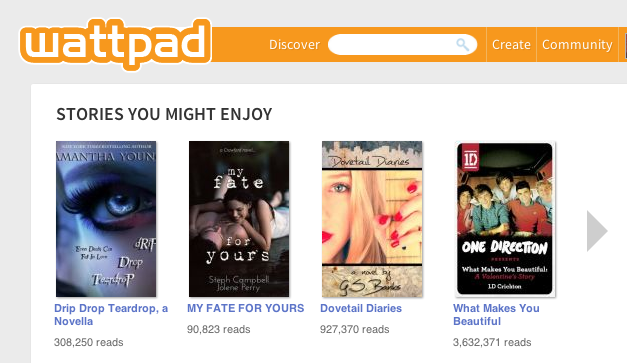
There are also new experiments taking place that are outside the traditional publishing industry and gaining traction with writers ranging from aspiring to emerging to established. Wattpad is perhaps the most notable example. Some describe it as Instagram for authors, some see it as a way of crowdsourcing the usually individualistic activity of writing, others see it as social media meets the world of the word.

Wattpad: Bringing the community element to the world of books

And where does this all leave you, the aspiring author? Worse off, or better off, as a result of the opening up of publishing via digital processes and platforms? Only you can make that determination for yourself, but remember that stat from earlier in this post, that 75% of self-published authors earn less than $500? Well, the accompanying stat would be that 25%, or around 100,000 self-published authors make more than $500. And this figure of 100,000 authors earning at least $500 would have pretty much been zero a few years ago, because the systems and technologies that enabled direct routes between author and reader simply did not exist. So while you will probably not become the next E.L. James by going the self-publishing route, the ability to give it a shot has never been better. We are all only limited by our own excuses, and I guess that's the double-edged sword that is the good news and the bad news.


Blog Bonus section: All this talk about 'free' eBook publishing...But what does it really cost to do your own eBook?  Click here and here for more.