Sunday, March 1, 2015

Notes from Podcamp Pt 2: Niche-o-nomics

And now, part 2 of highlights from Podcamp 2015 held recently in Toronto. If you missed Part 1, which looked at the future of content consumption in a world of multiple screens and necks crooked either downward or upward, you can catch up by reading it here. 

If you’re not committed enough to do so, that’s okay too, because today’s post picks up on themes explored not only in the previous post but all over this blog, namely the shift from a primarily mass media broadcast environment of limited choices to a cornucopia of niches in which pretty much anyone can publish, podcast, vlog, and blog.  

Now, there are those who have said yes, anyone can throw their stuff up online, and who really cares, because they probably won’t get anywhere. And in the early days of YouTubing and podcasting that was largely true. Sure, there were occasional ‘viral videos’ that moved around the Internet at the speed of greased lightning; but in many ways viral videos were the worst thing that could happen because they fell into the ‘one and done’ category. The chances of your baby, pet, or grandparent doing that unbelievable thing a second time are almost nil. Out of viral videos with tens of millions of views, careers are not generally made.

But what about a more modest level of success? Something a long way from household name type of stardom, and not enough to get you into a lease for a late model car…but what if you could do more or less what you wanted to? And if the money follows, that’s great. But that’s not the primary objective.

The Internet is the perfect place for such pursuits...as we’ll see from this roundup of the Podcamp panel I attended called Niche-o-nomics. Unlike the world of broadcast media, the Internet loves a niche, and these folks shared some of their stories about the benefits of choosing a thin slice of the market and sticking with it. The panel’s moderator was prolific podcaster Anthony Marco and the panellists were Greg David of www.tv-eh.com and Emily Gagne of the ‘girl powered TV site’ Cinefilles (pictured below, L to R).


Things learned during the panel:

-       Greg David was a writer for TV Guide for 15 years…until that day he got called into the boss’ office and realized that because the HR person was also there this wasn’t going to be a meeting about giving him a new column

-        After getting laid off Greg needed to figure out what to do next. He remembered coming across a website called TV Eh, a fan site devoted to Canadian TV shows and the Canadian television industry. It had been run on a volunteer basis by Diane Wild and and had been lying fallow for a while. It had a great brand and great content, so Greg explored picking up the blog baton.

-       But some sort of funding was required. Why don’t we do an Indiegogo, thought Greg. To his surprise, the campaign was embraced not just by fans of Canadian TV shows, but also by Canadian TV executives, broadcasters, and writers.

-       "Once people found out what we were doing we were getting pitched like crazy, and getting better stuff than I did at TV Guide….because people knew we were passionate about this specific topic."

-       The panel concurred: Traditional media is used to rapid fire questions from the interviewer that will be cut down to a 30 second clip for broadcast. With our format people can slow down and talk for an hour because we’re not about filling schedules and formats with soundbites and our audiences wants more, not less.

Moderator Anthony Marco then asked the panelists:

Is the key to success establishing your niche?

The answer: A lot of years – of paid and unpaid work – that’s ultimately what establishes credibility.


To check out the credible podcasts and blogs discussed in this post, click here for the TV Eh podcast and here for the Cinefilles blog. 


Next week: I'll be heading to Austin for SXSW and the Interactive portion of the festival. With any luck I'll be posting some highlights from the festival and/or pictures of oversized helpings of food, should I encounter phenomena such as Texas toast.

Image courtesy www.thisiswhyyourehuge.com

For SXSW 2015 Post #1 click here

Related Posts: 

The 3rd Wave of Podcasting, And How We Got Here
Podcasting: Art, Craft, or Reaching the Niches?
Podcasts outnumber Broadcasts 2-to-1 on iTunes charts
The Economy of 'Big Enough'
YouTube & filmmakers: From the small screen to the big screen..or not

Sunday, February 22, 2015

Notes from Podcamp: Fragmentation Nation

An interest, nay, preoccupation of mine for the past few years has been not just the fragmentation of the media marketplace, but the ultra-fragmentation. The podcasts, blogs, Instagram, Pinterest, and Vine accounts, music streaming services and Souncloud, YouTube channels, and  the rest of the sites, apps, and platforms that make it possible for anyone, anywhere to publish or broadcast their wares. And this is so much more than the fragmentation we came to know from, e.g, cable television or satellite radio. This is an exponential phenomenon that is often more than we can fathom -- and at the same time is becoming the norm. Trying to use a pie chart to illustrate the point is, for these purposes, essentially useless.

This week marks two years since I started writing this blog, and when I look back at the first post I am reminded of all the media forms that have emerged even since that time and also of how new intermediaries of the digital world are accumulating audience, and in turn, power in a way that the titans of the old broadcasting world did. Hopefully this is more than just ‘meet the new boss, same as the old boss’, but I suppose time will tell.

Nevertheless, in this world of publishing plenty, of the millions of blogs, podcasts, YouTube channels, and websites, catering to every niche out there, the new axiom seems to be:

if you can imagine it, it exists

Our media diet has gone from one of limited choices that were fed to us to one that grows unchecked each day on which we can gorge ourselves. How this works, from the perspectives of logistics, economics, production, and consumption is a work in progress, and is why I do this blog.

That’s why attending events like Podcamp, as I did this past weekend, can be so interesting. It’s an ‘unconference’, meaning it’s participant-driven, not organizationally or corporately driven, and is typically free to attend. I’ve gone to the last two held in Toronto, and in both cases about 1000 people converged on the campus of Ryerson to take in this ‘let’s put on a show’, with panels taking the place of song and dance numbers. Real stories from real people doing their blogs, vlogs, and podcasts, from reasons ranging from hobby to job.

Today Part 1 of some notes from Podcamp, followed by Part 2 in the days to come. 


A selection of Toronto Podcampers, February 2015

    
Just a few of the sessions on offer at Podcamp 2015

I popped in and out of a number of sessions but one that not only stood out, but also spoke to the larger themes of how we arrived at this point in the media timeline and where we might be headed, was hosted by James Wilkinson. James’ website describes his skill set as: Interaction Design, User Experience, Content Strategy, Social Media, Web Design, Creative Direction, Mobile Applications, Web Development ...which makes it reasonable to assume this guy knows what he’s talking about. (Note: You never really know at an unconference, so caveat emptor, etc).

The session was called “The future of content consumption”, but rather than being one of those bleary-eyed looks at a Jetsonian utopia, it was as much about the past as it was about what is to come. In framing the then vs. now James put things simply yet succinctly.  “Someone else used to create, someone else used to curate.”

As you'll note in the slides below, it took us thousands of years to get from smoke signals to the telegraph, but only about twenty to get from the rise of the consumer Internet in the mid 1990s to the social media juggernauts of YouTube, Facebook, and Twitter -- and the device that changed everything, the iPhone.


Previously expensive, fairly specialized gear, all squeezed into one chocolate bar sized gadget.


The new norm is billions of pieces of content, made by us, made for us, recommended to us, targeted to us, or sought out by us, and across a panoply of screens that many own: phone, tablet, laptop, desktop computer, wearable device. There’s also the “Internet of things”, in which computing capabilities are embedded in objects ranging from appliances to clothing, furniture, and even pills. You probably don’t think about it, but today’s cars now have millions of lines of code in them.

A miniature Times Square at Toronto's Yonge-Dundas Square
The takeaway: Get used to more connections, across more screens. And these screens include not just the ones in your pocket or your home, but also ones in public places. To this end, here’s a new acronym for you: DOOH. Which is not to be confused with Homer Simpson’s D’oh. DOOH stands for digital out of home, a type of digital signage found in outdoor, retail, and special event environments, that has the ability to communicate directly to us, and vice-versa. There already is, and will continue to be, an increasing seamlessness between our own screens and these screens. The digital signage at McDonald’s and Tim Horton’s or downtown plazas is just the beginning.


“The future is smart”, said Wilkinson. “And scary”, said an audience member.

Whether or not it’s as scary as some would lead us to believe is another one for the  “remains to be seen” file. There has always been techno-fear mongering and while some of it certainly has a basis, I’ll take the net benefits of technology over a world without it any day. It’s obviously a much larger debate, and one that I’m not going to get into here, but to grossly oversimplify things, it’s the price we pay for 'always on' media and on-demand information and entertainment...and the fact that we directly  ‘pay’ for very little of it. So payment takes other forms. Deal with it? Yes, we're all trying.


In Part 2 of this post, a look at the realities, and advantages, of working in a content niche. 

Related Posts: 

Podcasting: Art, Craft, or Reaching the Niches?
Podcasts outnumber Broadcasts 2-to-1 on iTunes charts
Why PBS moved from 'owned & operated' media to YouTube

Friday, February 6, 2015

YouTubers in 2015 Part 2: A king of trivia and a girl-next-door beauty blogger

The celebration of the 10th anniversary of YouTube continues here on the blog, with Part 2 of a look at the state of YouTube creators aka 'YouTubers' in 2015. (Click here for Part 1, featuring one of the people behind the Annoying Orange, aka the unofficial cartoon of YouTube).

By now you may know about some of the biggest YouTube stars out there, such as PewDiePie, Smosh, Jenna Marbles, and The Fine Brothers. These are people with millions of subscribers and billions of views, and while the names may not be familiar to you, the videos may well be. And if you have kids under 15 or so, that is almost definitely the case.


But these billionaires of YouTube views like The Fine Bros., producers of the "People React To..." videos, are the exception. More interesting -- to me at least -- is that there are about 6000 YouTubers each pulling in over a million views per month. At a recent digital content conference held in Toronto I had the opportunity to attend panels featuring assorted 'Tubers telling their tales and today, some nuggets from two more: Rachel Cooper of the RachhLoves channel and Matt Santoro, the guy on YouTube who does those 'amazing lists' videos that attract tens of millions of views per month.

First, let's hear from Rachel, one of about 50,000 beauty bloggers on YouTube.


For some it's a hobby, for some it's a part time job that supplements their income, and for some, such as Michelle Phan, it's been the path to getting their own makeup line with L'Oreal. For Rachel, recently married and with a baby daughter, it's a full time job, and one that now also employs her husband. She posts two videos per week, on a consistent schedule, and each video runs around 5 to 6 minutes. When she started posting videos a few years ago it wasn't about money, because nobody was making any. "It was about community and making friends online and just having fun" she told the crowd at the conference.

Rachel is part of the Style Haul network on YouTube, which is home to about 5000 YouTubers creating content related to beauty and fashion. While not everyone's YouTube MCN, or third party multi-channel network experience has been great, most notably the Annoying Orange's as explained in Part 1 post, Rachel says she's happy with hers. Among the things it brought her that she says she probably wouldn't have achieved on her own are increased visibility, opportunities for collaboration, a web series, and a deal with Unilever.

To me, personally, beauty bloggers' videos aren't interesting  (I still have no idea how to do a 'smoky eye'...maybe I should watch the channels once in a while?) but what is interesting is how many of them there are, and most come from the humblest of beginnings...literally shooting videos in their bathrooms with a headband on and a makeup palette and flat iron just a few inches away. And yet, they're able to pull in hundreds of thousands of subscribers and millions to billions of views. Whereas a previous generation of girls and young women flocked to magazines like Seventeen and Elle for beauty and fashion tips, today it's a much more fragmented landscape, spread across the 50,000+ beauty bloggers and their often niche areas of expertise. What is too various to be covered by mass market magazines and broadcast networks works perfectly for an army of YouTubing young women and their video selfies.

And if there's one thing the Internet has taught us it's that people love lists. So when it comes to lists of particularly mind-blowing facts, it shouldn't surprise us that one man can generate tens of millions of views per month doing videos that regale us with this trivia. Meet former accountant and now full time YouTube video maker Matt Santoro.


Matt told the audience that he didn't want to perpetuate the stereotype of one guy in his apartment making videos and throwing them up on YouTube, when in fact that's exactly what he does.  "If I had more funds I'd have more people...writers, social media person, editors...but I'm everything. If I had just a writer I could triple my production but I'm still just a 1-man show."

When he was posting one video a week Matt's monthly view count was around 23 million, he told the crowd at the conference. One he added a second video per week his monthly views jumped to 35 million and he says it's now closer to 40 million views per month.

The many obsessions of Matt Santoro, in easy to digest list form

"I get a lot of brand deal offers through my YouTube network The Collective (incidentally, the same network with which the Annoying Orange production team is embroiled in a lawsuit). They get me deals to do things like fly to L.A. to do the YouTube Super Bowl half-time show and I also do integrated brand stuff when it feels right, which means I tweet about things and post on social networks, but the number one thing for me is that it has to feel right. I value the trust I've built with my audience. That's the most important thing."

When asked how he keeps up with all the research, writing, production, marketing, and personal appearances that are part  being a 1-man show such as he is Matt ascribes it to two things: "empty bottles of vodka and a lot of crying."

"For the first four years I really didn't make any money. It really just blew up last year. What other job would you do for four years, make almost nothing, and still do it?  You do it because you love it. When I started  making the same I did as an accountant, by uploading 1 video per week, that's when I decided to take the plunge and do it full time. And people know it's not teams of people, yet if I don't post on the day of the week I usually do people are hitting refresh every minute and sending me tweets and emails saying "Matt, where's the video?"

Talking to and/or back to YouTubers? All part of the job in this world of direct-to-fan media and 2-way communication. Which is another way of saying this ain't your mama's TV show.

Related Posts:

YouTube's first North American Fan Fest: Fans love YouTube & YouTube loves its fans
How bloggers with selfie sticks became brand allies

Tuesday, February 3, 2015

YouTubers in 2015 Part 1: The appeal of the Annoying Orange

One of the aims of this blog, now 2 years into its existence, has been examining and then breaking down the economics of the creative industries in the digital era. Why? Because in a little over a decade we’ve gone from industries worth double and sometimes triple digits billions to revenues that are now valued at a fraction of that as people move from purchasing CDs, DVDs, movie tickets, books, newspapers, games, etc to streaming music, playing freemium games, getting news on the web and on apps, getting getting what used to be called radio through podcasts, and getting what used to be called TV shows and movies via Netflix, YouTube, or torrent sites.

Today’s post will be a kind of turbo history of YouTube, from its earliest days as a repository of nothing in particular — people’s home movies, random clips of trips, pets, and kids, illegal uploads of old commercials and TV shows and music videos — to today, where it accounts for more 18-34 year old viewers than any television network. 

The first video was posted to YouTube on April 23, 2005. In those days randomness ruled, as nobody knew what the platform was best suited for, and the wild west mentality of uploading things for which didn't hold licenses or copyright was on its way to becoming a new norm. Within a year and half of the chaos of the early days Google acquired the startup for $1.65 billion and today, just short of ten years since its inception, YouTube is a primary platform for a new generation.
This journey from digital dumping ground to entertainment industry power broker was very much on my mind recently when I attended a digital media conference in Toronto. And one thing that’s becoming increasingly clear is that we’re moving toward a world of (at least) two YouTubes. One is the world of the weird and quirky ‘Internet famous’, and the other is the world of YouTubers of more mainstream and even corporate appeal. 

Yes, the eccentrics and anomalies are still there, and always will be, but as YouTube evolves and matures, we have the co-existence of the weirdo world of YouTube with the one that favours those with millions of views per video, as well as agents, managers, and video network affiliations Pioneering philosopher of the digital age David Weinberger has come up with a characterization for today’s interesting underbelly of YouTube. He calls it “mass net fame”, and explains here how the Internet in general and YouTube in particular “… enables mass marketing of culture, resulting in old style fame being foisted on us, as well as the Bieberization of talent that first emerges bottom-up and then gets absorbed and re-emitted by the mass media. The Net allows for both of these modalities simultaneously.”

With this cultural tug of war in mind I bring you highlights, in two parts, from the recent Digital Dialogue 2015 conference held in Toronto. Today, it’s the pulpy story of the Annoying Orange (at least I didn’t say juicy) and in the days to come I’ll follow up with a post on the day’s other panelists, amazing lists guy Matt Santoro and beauty blogger Rachel Cooper of the RachhLoves channel.


So, you may ask, who is this Annoying Orange? Well, as the name suggests, he is an orange, but not just any piece of citrus fruit. This one has 2.5 billion YouTube views and over 4 million subscribers and a kind of media empire comprised of sub-channels on YouTube devoted to characters from the series.

From the Annoying Orange camp we heard from Bob Jennings, producer, and voice actor for the series, most notably as Grapefruit.

On the origins of the Orange

Jennings, who got his degree in film from Boston’s Emerson College and had a day job at the American Film Institute, told the crowd it all goes back to January 2006 and the Wicked Awesome Films YouTube Channel. He and his friend Dane Boedigheimer uploaded a video. Jennings remembers: “Within two minutes we had a comment…from Australia…so I said I’m in!”

It was so early in YouTube’s history that there were no thoughts about money. People just made videos and uploaded them because they loved doing it. 


The Orange expands

When asked by the panel's moderator YouTube’s David Brown on the moment when he got hooked on YouTubing Jennings said: “On YouTube you don’t need permission. It’s a two-way stream with the audience. But things really started to pop in 2009. There was nothing like Annoying Orange online. Even our thumbnails didn’t look like anyone else’s. We got a huge young audience and it really became the unofficial cartoon of YouTube. Then other YouTubers like Shay Carl got in touch with us wanting to be involved and then James Caan called and wanted to a Sonny Corleone character talking to a grapefruit." 


                            James Caan takes on a new thespian challenge as Jalapeno

The Orange and its Audience

Jennings tells the crowd that the primary metric was number of views up until recently. Now it’s ‘watch time’, or how long viewers stick with your video, also where your videos get placed outside of YouTube (e.g. posted on Facebook, a primary driver of traffic to YouTube . "And actually gamers taught me a lot about making content that makes people keep coming back."

The Orange Moves to TV

In 2011 in one of the first deals to see a YouTuber move to television it was announced that Annoying Orange would be seen on cable television channel The Cartoon Network. But Jennings admits: “The show is way bigger online than on TV. The problem is we have the brand and advertising dollars backwards…with more of them going to TV when they really should be showing up online.”

The Orange joins a YouTube network, or MCN (multi-channel network)

For a lot of YouTubers the path to optimizing revenues is by way of an MCN, or network that aggregates thousands, if not tens of thousands, of YouTube channels, and strikes deals with brands and advertising agencies that are more favourable than deals available to an individual YouTuber. That’s the theory at least, and for some it pans out. Not so for the Orange, however. “The Collective (Annoying Orange’s network) hasn’t paid us for 5 months. The story is in the Hollywood Reporter if you want to know more. Now we’re in a legal battle.” Jennings continues: “So we just started our own company, New Media Trader, to connect brands with creators."

Click here for Part 2 of this YouTubers in 2015 post.

Tuesday, January 20, 2015

Jesse Brown, the 1-man thorn in the side of Canadian media

A fairly quick post tonight, just to bring you some notes and photos from tonight's event at the School of Journalism at Toronto's Ryerson University, where controversial blogger and podcaster Jesse Brown, the man responsible for breaking some of Canada's biggest media scandals in recent memory, did a talk entitled "The news, Jian, and me". Turns out the evening wasn't so much about the Jian Ghomeshi scandal as it was about Jesse's damn the torpedoes style of journalism and his views on the state of Canadian media, but that was fine by me. I've had more than enough Gho-media coverage and was happy to instead hear about how Jesse went from struggling freelancer to man of the moment in the Great White North.

L to R: April Lindgren, Jesse Brown, Greg Elmer

Brown was interviewed by Ryerson faculty members April Lindgren and Greg Elmer and also took questions from the audience. Heck, I even managed to grab the mike long enough to lob my softball question at the man of the evening. More on that in a bit. Ed. Note: As I was scribbling notes on my lap some of the following are not verbatim quotes, but I stand by them capturing the spirit of what was said tonight. (Don't sue me, ok?)


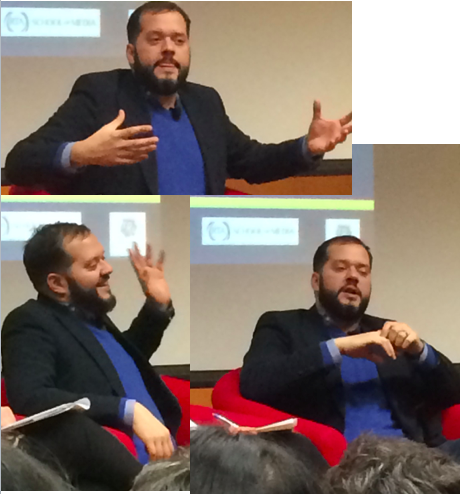
A few of Jesse Brown's hand gestures, Ryerson University, Toronto, January 20, 2015

Jesse Brown on his business model:

I have an aversion to doing things for free. This is not a vanity project about tossing grenades, so I sought a corporate sponsor, and the first guy I approached, from Freshbooks, said sure. He funded me for 6 months. And then when that ran out I went to companies like audible.com who sponsor podcasts, but they only throw a bit of money your way when somebody actually clicks through and signs up for their service so it wasn't enough to cover expenses.

The best sponsor would be a whiskey company because people now know when they come on the show that it's going to be a bit of a confessional. I really should have a two drink minimum.

As for the business model, I had to look at other ways to make this thing sustainable. I didn't want to do a Kickstarter, because that's a one-off lump sum of money. So I decided to use Patreon, where people pledge as little as $1 per month and as much as they want to, and they can quit any time. Within 24 hours I hit a funding level of $1000/month. Within a few week I was up to $4000/month, at which point I pledged to do (the blog and podcast) Canadaland full time. Now (as of late January 2015) I'm almost at $10,000/month and then I'll hire freelancers and will start another podcast, devoted exclusively to politics.

On the popularity of the Canadaland podcast & the Ghomeshi effect:

Pre-Ghomeshi I was getting about 17,000 downloads per week. That then spiked to about 250,000 downloads during the height of the scandal because it was something everybody wanted to know about. Now things have settled down to about 60,000 downloads for the two shows I do per week.

On his beef with media organizations in general, and CBC in particular

There's a sickness in media organizations...a set of rules for the 'stars' and another one for the rank and file. This has been festering for a long time and people want this stuff out. I'm a big supporter of public broadcasting but they (the CBC) have strayed wildly from their mandate. Why are they doing things like streaming music services, trying to compete with Pandora and Songza? And why are they trying to make stars? Strombo is a celebrity we never watched. Ghomeshi was on billboards with shows that weren't successful. It was only later, when they finally found the right platform for him (with "Q") that reality caught up with the manufactured celebrity.

Screen of my Apple TV and what I see
when I click on 'Podcasts' on the menu.
Note Jesse's show Canadaland
is in the 2nd row, 2nd from left
Then it was open mike time, and I managed to get in there with my question, which had to do with how I came to know of his podcast. I mentioned that I had been out of Canada for close to 6 years, having returned in the past year, and that this summer I started exploring the podcast menu on my Apple TV and noticed that there was a show, in there with all the CBC and NPR shows, that was new to me so I clicked on it. I listened and it turned out it was a Marc Maron-like one-man show, and I always wondered how somebody without the profile or budgetary resources of the shows from big broadcasters/networks gets 'front paged'.

We tend to think that these things happen via algorithms or something equally cryptic, but in this case, apparently not. Jesse said he just made a point of finding out who was in charge of curating the podcasts for Apple/iTunes and that person was always on the lookout for new and interesting material and agreed to feature Canadaland on the front page of the podcasts menu. "Apple has been very supportive", said Jesse, before pointing out that an exchange student later contacted him after seeking out information about Canada on iTunes and thinking Canadaland was a show with information for newcomers to the country. "The two of us then worked on a story together about how exchange students get screwed when they come to Canada."

Still want to know more? 

For a live blog of the event courtesy of www.jsource.ca, click here.

For a feature length interview with Jesse Brown there's this new podcast, devoted to an examination of public broadcasting.


Related Post: When media scandals meet social media 

Wednesday, January 7, 2015

Podcasts vs. Broadcasts: Who's on top on the charts?

One of the things I love about life in these Internet times is that if I can imagine it, it probably exists. This has been the case on YouTube for several years and more recently in the world of podcasting. As a former radio person myself I was hoping this cornucopia of content would come to be with the advent of satellite radio in the early 2000s, but alas no. That, sadly, largely turned out to be a variation on the same old morning zoo formula, or, arguably worse yet, castaways from commercial radio. OK, yes, the odd interesting thing made it to satellite, but overall a hugely lost opportunity to do truly interesting things with at home and in-car audio that for the first time could break out of geographical boundaries, formats, and finite time slots. Oh well.


In between now and then I have done probably 99% of my listening online, whether it’s to music streaming services, radio stations that use the Internet for live broadcasting and archiving their shows, or to podcasts that live exclusively online. And why not. The world is now our audio oyster. Furthermore, I have no trouble confessing to being a binge listener. 

I love that so many podcasts defy categorization. They aren't exactly journalism or even entertainment in the way broadcasting has long defined entertainment…with genres and formats, timed and packaged and built around segments that move briskly from one shiny object (or audio equivalent) to the next. And what's more, the people tend to talk like, well, real people, and what would have once been considered bungles or outtakes are just left in..the coughs, the mistakes, the mispronunciations. It's about the content, not the slickness of the production, or the dulcet tones or ego of the announcer, and in this way it has opened up an entirely new universe of possibilities.


So along I went, listening to hours and hours of podcast accompaniments as I rode transit or pounded the pavement to and from meetings and events. Then, a few months ago, this happened: The mainstream media proclaimed that 2014 was the year podcasting officially broke through. After ten years of being around, and ironically, the same year the iPod classic was discontinued. There were now more than 1 billion podcast subscriptions and a monthly listenership of 75 million, a 300% increase from 2009.

But...why now? The easy answer is that all the pieces have come together, which is actually a complex network of people, technologies, and behaviours that generally require years to take root. As the world seems to love a listicle, let's go a bit deeper on this topic, but in an easy to digest, bullet pointed way.

5 reasons why podcasting broke in 2014
  • Internet access or sound file playability in cars
  • Distribution through personal recommendations on Facebook, Twitter, etc
  • Emergence of podcasting networks as filtering and discovery mechanisms
  • Smartphones and apps have turned our favourite small screen into portable personalized media machines, usable while we’re pedestrians, transit passengers, at work, and while driving, using the odd aux cable or technologies such as Bluetooth. 
  • Podcasts are multi-purpose media, encompassing everything from hobby to art form to educational outreach to product marketing and perhaps, most annoyingly, self-marketing, but what can you do. (Wait, I know. Not listen?)

Also, unlike satellite radio, they're mostly free and don't require additional subscriptions or equipment. But there’s podcasting and there’s podcasting, and until quite recently the podcast charts were dominated by shows that were radio shows that just happened to be made available as podcasts. Not the same thing. And not because I’m a pod purist, but because I’m interested in the what, why, and how of things outside the infrastructure of mainstream media finding their audiences in ways other than legacy systems and mass marketing. 

Now, yes, there were a handful of what I will call ‘podcast native’ shows that were always high in the iTunes charts, most notably Marc Maron’s provocative, one guy in his garage interview show WTF, and already established media personalities such as Adam Carolla who also rated highly. But for the most part the podcast charts were made up of public radio programs, with organizations such as NPR, CBC, and BBC  making up the bulk of entries.

So, in the context of the breakthrough of podcasting so widely reported over the past few months I decided to run an quick analysis of the top podcasts to see if and how the ratio of broadcast to podcast native has changed over the years. As I am back living in Canada I used the iTunes chart as my data source, but the ratios for the US charts are almost identical. I broke down the top podcasts into categories of podcast native, shows that originated as broadcasts, shows that are hybrids, and added a few notes here and there. Oh, and these jpg's can be clicked on to be enlarged because I completely get that spreadsheet legibility is challenging in this format.


And if you don't have the time or inclination to do the math yourself, here's the quick tally: Podcasts, once the gangly, misfit younger sibling of professionally produced radio shows, now outnumber broadcasts 2 to 1 on the charts. We have 7 shows from NPR, 2 from CBC, and 1from Global News. Everything else on the chart is podcast native, or born on the Internet.  I should also mention that iTunes statistics are but a single measure of podcast consumption, as not everyone listens through iTunes, and the algorithm is a mix of downloads, subscribers, and possibly reviews...Apple doesn't say. Nonetheless they're standard, and as such are a reasonable indicator of the landscape.

But more importantly, what conclusions can we draw from this admittedly quick and dirty analysis? It seems pretty safe to say that the major media brands will likely continue to be well represented on these charts. They are home to high quality productions, skilled hosts and reporters, and excellent distribution networks. More interesting is that as time goes we're seeing the polished productions of the legacy institutions taking a backseat to things that start as hobbies, obsessions, or what the heck projects, and end up proving that there are gaps in the marketplace that the pros could not or would not see. And that there is, in fact, entertainment without an entertainment industry.


This post also appeared on Medium.

Related Posts: 
Notes from Podcamp 2015: Fragmentation Nation
Notes from Podcamp Pt 2: Niche-o-nomics
Podcasting: Art, craft, or reaching the niches?

Erratum: Thanks to broadcaster & podcaster Dan Misener for pointing out the following regarding his show: He writes: "A quick correction re: #28 in your list. Grownups Read Things They Wrote as Kids began as an indie podcast, then aired for a summer on CBC Radio, and is now once again an indie affair."