Monday, December 14, 2015

When media is everywhere where are we?

There used to be this thing called media, that happened on fairly expensive, unwieldy equipment, almost always kept indoors, and created by an elite group of people that presumably knew better than the rest of us. It was transmitted to us at first be relatively few channels, later by too many, and still it seemed there was never anything on we wanted to watch.

Today there’s this thing called media that still resides in our homes but it also resides in our workplaces, in our social spaces, and in the palms of our hands, where, each year, increasing amounts of it are created and consumed.

This means many things, some culturally significant, others entertaining or bad for our health. Or both. For example, thanks to the proliferation of mobile devices we (or is it just me?) often find ourselves annoyed in public spaces, at stores, and on transit; all because some people don’t consider that the world does not want to be privy to their extended conversations.  


Chiropractors of the world may rejoice, but many of us suffer from, or are apparently about to suffer from, ‘text neck’. 


And otherwise (presumably) rational people are succumbing to face plants in conspicuous places.


But beyond the ubiquity of communication – and the psychological and physical discomfort noted above – what are the ways in which we can better understand the effects of mobile media in relation to our environment?

Seeing that it’s the holiday season, the Demassed blog is offering up a platter of miniature cognitive sandwiches in the form of some issues on this topic that were recently discussed by the group assembled for the Monday night seminars, a tradition started by pioneering media theorist Marshall McLuhan during his teaching days at the University of Toronto. 

The topic on the table was: In the mobile world is there a sense of place?  Taking it on were:

Some thought starters were introduced to frame the discussion:

The concept of acoustic space: A space with no centre, no front, characterized by an “all-at-once-ness”, in the parlance of McLuhan himself.

The work of theorist Joshua Meyrowitz, who, 30 years ago, wrote an incredibly forward looking book on the impact of electronic media on our behaviour called "No Sense Of Place", introducing such ideas as the blurring of public and private experiences and the creation and merging of new identities created through our exposure to broadcast media. Bold thoughts indeed for 1985, and definitely following in the footsteps of McLuhan’s work on concepts such as the de-tribalizing effects of media; e.g. the printed word took us away from our ‘tribes’ because we could consume information privately, in isolation, away from our communities. Similarly, broadcast media has the power to re-tribalize disparate, large groups of people, on the basis that they are exposed to similar cultural expressions and norms. In other words, looking at our relationships with the world as media-ted.

The question of the evening was then posed: In the mobile world is there a sense of place? The discussion went on for an hour or so but in the name of brevity I'll bring you a handful of highlights.

Ferrara of the Institute Without Boundaries urged us think about, for example, big box retail as a response to the end of the physical world we once knew. It may be that mobile, rather than creating placelessness, allows the injection of place into everything. We are nomads and every place is part of our life as we move through it. Placelessness = industrial society and we are now post-industrial.

Cognitive Neuroscientist Ellard pointed out that the hardware in our brain wants to recognize particular places. Mobile devices intensify our sense of place; a new kind of awareness results. We now carry media-ting devices and the ability to insert and extract information on the go. This adds place-ful-ness to what otherwise might be placelessness.

Journalist and author Silcoff put it this way: We’re all armed with digital Swiss army knives, so how does this change our relationship to the world? Possibly by what we no longer have, such as the disappearance of things like the banks on the corner, that at one time were some of the grandest architecture in our everyday environments.  Instead we get decentralized, specialized cityscapes. Kids find their place in this world early, via screen time. Note that many of the younger generation don’t know how to use a paper map, because digital maps bring the world to wherever the user is and zero in on that location accordingly, whereas paper maps require the user to find his/her place in the larger landscape. 

Such inversions of context and power structures are typical of the Gutenberg revolution, as well as such McLuhan-inspired ideas as 'we shape our tools and then our tools shape us'.


Related Posts:

Wednesday, November 18, 2015

The 'everyday experts' taking over YouTube

It's time for Part 2 of my coverage of the gathering of YouTube celebs and enthusiasts known as Buffer Festival. (See Part 1 here.)

In this instalment you'll meet a trio of YouTubers who started out as 1-man / 1-woman operations and now net from several thousand to several million views per day each.

Treading on what was once the exclusive domain of public broadcasting, YouTubers Craig Benzine, Dianna Cowern and Matt Santoro all started uploading videos for nothing more than the heck of it.  Read more here.

YouTuber Matt Santoro asks questions millions want the answers to

Tuesday, November 17, 2015

How bloggers with selfie sticks became brand allies

Where industry once created stars, now it often follows, as is the case with the people-powered celebs of the Internet who are then pursued by broadcasters, movie studios, book publishers, and brands.

Click here for the blog post I wrote on the topic, featuring an interview with Corey Vidal, founder of Buffer Festival, an annual conference, get together, and fan event for YouTubers...and the people who love them.

Corey Vidal, 3rd from left, holds court with assorted stars of the YouTube small screen at Buffer Festival
source:www.bufferfestival.com

Related Posts:
The Everyday Experts Taking Over YouTube

Monday, November 9, 2015

Hooked on Addiction?

Like many people, I, at one time, had an addiction to the TV show Intervention. I took my first hit quite by accident. It was while channel surfing one night ten years ago and this guy, Gabe the gambler, appeared on my screen. How the heck could I not be transfixed. This kind of stuff was simply not show on television back then.


10 years later Transfixed would be the name given to a symposium that accompanied the Rendezvous With Madness film festival, currently in progress in Toronto. Both festival and symposium are devoted to the (un?)holy trinity of mental health, addictions, and their depictions in the media.  

I was so there.

The symposium was a day long panel event, but in reality more like a live talk show, where discussants and audience members were able to take in the frankly quite harrowing tales of addiction from people ranging from a one-time NHL star to a punk rock icon, and to do so alongside mental health professionals and media studies professors. If that doesn’t hit all the buttons, I don’t know what does.

Source: www.rendezvouswithmadness.com

The narratives of despair and despondency speak for themselves; though, as one panelist noted, their over-availability in the media can turn them into a perverse form of entertainment, as opposed to cautionary tales.

Having the media studies interest/bias that I do, I wanted to share a few highlights from the day’s discussions. Some truly penetrating insights were shared around the collision of a 24/7 media and technology-enabled world and portrayals of addiction -- whether they originate from fictional shows or movies or from reality TV.

Referencing academic work on the topic of ‘subalterns’, or those who exists outside the domains of conventional power structures, Scott Henderson, a professor at Brock University, spoke of the concept of immediacy, of everything being at our fingertips at all times. Immediacy, said Henderson, used to be the domain of the marginalized, pointing out that those with status or privilege pursued the stable, not the unknown. Immediacy and notions of taste were once at cross-purposes with each other.

Henderson also made an astute observation about auto-play as now being a default setting on YouTube and Netflix – that’s when the videos or shows just keep on going, unless you actually budget from the couch and do something to stop the process. What this does, as Henderson noted, is create a media environment with no beginning or end. It’s an ongoing carousel of programming in which we are constantly tempted by the allure of a better ‘something else’. As a result, it is not unusual for people to spend an entire evening clicking everything but watching nothing.  More choice doesn’t have to necessarily mean less control, of course, but the behaviour that many of us are engaging in is undeniable.

Ken Rogers, a faculty member at York University’s School of the Arts, Media, Performance and Design, spends a lot of time thinking about the relationship between media formats and their effect on our attention. Heck, he’s written a book on the topic. Rogers drew an interesting analogy between our use of media products and the pharmaceutical industry, where the same drug -- particularly in the case of opiates -- that is the cure can also be the culprit.

The difference, then, is the context of consumption. He went on to talk about freemium games, which are online games you can play for free, and then opt to buy additional tools and widgets to enhance your game play. If you’ve ever been pulled in by more rounds than you had expected of Angry Birds, Farmville, or Candy Crush you are likely nodding in agreement, acknowledging the slippery slope between playing a game, and having it play you. 

If this is sounding foreign to you it may be worth considering this thing called ‘the grind’, which is central to the design of many video games. The idea is that the flow of the game play is structured so that events happen that provide our brains with jolts of dopamine, so that we not only keep playing, but that we want to step up the level of game play, which is only possible, of course, by buying the additional tools or ‘lives’, so you can keep on slingshotting rocks at birds or obsessively lining up chocolate squares on your screen.

As Rogers put it, we think of attention as something that we own, that is ours, when in fact it is something that is transactional. We trade it for other things, and ideally the trade-off is a deal that is good for us, but as is the case with most deals, caveat emptor.

Tuesday, October 13, 2015

The 3rd wave of podcasting & how we got here

It is “raucous and…conversationally rich…and stupidly comforting”, wrote Nicholas Quah, describing the singular nature of podcasts in HotPod, his newsletter on the dramatic changes taking place in the world of direct to listener audio production aka podcasting.

And it is now into its third wave, according to people who got their feet wet during wave one of the podcast revolution. 

We'll hear from a group of these early waders shortly, but first a quick surf through the chronology of the audio format that broke free from the confines of broadcasting formats and the things with knobs we came to know in our homes, cars, and workplaces.

2003- 2008
Wave 1.0

The pioneers doing the homesteading, without much in the way of commercial intentions or aspirations. Apple incorporates a podcasting platform into iTunes midway through 2005, making it a built in feature for the at first tens of millions, then later hundreds of millions, of iPods in circulation. During this period the first iPhone was released (June 2007), creating another ‘baked in’ environment for podcast distribution and consumption.

2008 - 2014
Wave 2.0

Apple launches app store (2008), the superstars-to-be of podcasting start podcasting, e.g. Marc Maron, Adam Carolla, Joe Rogan (2009), the number of podcasts produced doubles during this period, and mobile phone penetration triples.


2014 –  ? 
Wave 3.0

Serial – the most listened to podcast in history, breaks the record for fastest time to five million downloads and leads to the public perception that 2014 is the year podcasting broke. The ecosystem of devices, creators, listeners, apps, distribution platforms, discovery via recommendation, sharing, and/or reviews reaches a point of maturity. 


It should come as no surprise then, that podcasting was recently given a forensic, this-is-your-life treatment at an event called State of the Podcast 2015, hosted by the Berkman Center for Internet and Society in Cambridge, MA.

A panel comprised of esteemed podcasting pioneers and practitioners, and moderated by Harvard Law School clinical professor Chris Bavitz went back in time to recall the early days of the technology, and the form, and went on to share their views on where things are likely to go from here.

The panelists: Broadcaster and Podcaster Christopher Lydon, Kerri Hoffman and Jake Shapiro of PRX, and Benjamen Walker host of Theory of Everything Podcast. The discussion went kind of like this:

Christopher Lydon:

In 2003 blogging was the first run of the podcast world; it had all the “crackle & pop of media” but with added enthusiasm and openness. Dave Winer, credited with inventing blogging, thought what the world needs is an MP3 that can be syndicated, and the result was the first podcast, that I hosted in 2003.

It coincided with the beginning of the war on Iraq, when 70% of Americans thought Saddam Hussein was behind 9/11. The New York Times should have been running banner headlines, but it was bloggers and podcasters saying things no one else was. 

It was the restoring of public conversation that had become dilapidated, and this became a place to have a reasonable conversation.

Benjamen Walker:

Between around 2004 and 2006 there was a lot of excitement in the field --  and lots of gigs as ‘podcast consultant'. Then came the dead time, and now it’s the time of hype, with the money trucks dumping money everywhere, but I think that rather than focusing on that we should be thinking about what comes next.


The term 'podcasting' hits peak Google circa 2006

Jake Shapiro:

PRX (Public Radio Exchange, an online distribution platform for digital audio and radio programs) was launched in Fall 2003. RSS for audio seemed like a silly, trivial thing at that time.

Odeo, a podcasting platform founded in 2005, was the first interesting startup in the area (started by ex Google employee Evan Williams). 

Ed. Note: And from the ashes of Odeo came a messaging app, first called Twttr. You probably know it by its more fully voweled name.

That same year Apple caught on to the surge of interest in podcasting (leading to the demise of Odeo) and incorporated a podcasting platform into iTunes. This also built the technology into the 30 million iPods that were then out there, a number that would reach 400 million by the end of 2014.


The second wave of podcasting was accidentally triggered by Apple, with the launch of the app store and the iPhone. People realized ‘these aren’t just smartphones…these are radios!’ Audio had been a bad fit for the web, but mobile could fix this, and mobile has become the way for billions of devices to become a listening platform for audio.

Kerri Hoffman:

In 2003 we had a tagline we used for PRX: "Making public radio more public". It was a moment of having direct to consumer consumption of media, news, stories, investigations – it’s what podcasts have enabled

In 2014 we launched the Radiotopia network, to build a platform for talent, people like Ben (Walker), and to consolidate the back office, things like marketing, cross-promotion, and sales. Within 2 years we’ve increased our growth by tenfold. This tells us a lot about the public’s interest in consuming this kind of content, about the ubiquity of the technology, and that the shows can survive. For a long time shows would get to a certain size and then plateau. That’s why this is an exciting time for what comes next.

Benjamen Walker:

Thinking about the waves of podcasting -- I see it more as a Rashomon narrative -- all 3 happening at the same time: The technology story, with Dave Winer and RSS, the money story, in which Roman Mars hijacks public radio model with his Kickstarter for 99% Invisible, and now the art form story.            

I think people that are making a lot of the great podcasts are people who left public radio because they could do more on the outside than the inside; so I feel like public radio isn’t taking the risks they once did.

I teach a podcasting course at a university in NYC and it’s interesting…none of the students want a job in public radio – they want to be the next Roman Mars. They want to do their own podcasts.

Kerri Hoffman:

The risk point is a good one. Part of the future will be a lot more experimentation, a lot more fails – and that’s not something that public radio is accustomed to. By the the time they launch a show they’ve done a million polls and pilots. In podcasting, where it’s digital only, a network effect of like-minded shows and talent is what’s going to get the lift.

Moderator Chris Bavitz: 

Are podcasters now playing more to advertisers? Is it becoming a more commercial medium?

Kerri Hoffman:

The producers we work with can always say no to advertisers. What advertisers are waking up to is that listeners are selecting, they’re subscribing…they’re a more dedicated fan base, and the advertisers are waking up to that reality. Since we work in both broadcast and podcast we’ve seen a shift of some of the dollars from the broadcast to the podcast side…and that wasn’t happening even 2 to 3 years ago.

Benjamen Walker:

Advertisers jumping on the hype train can benefit us all. The discovery piece is so hard, with so many podcasts out there – some people hear an ad, according to research, and think ‘oh, ok, this is a good podcast'...because it has ads on it.

Kerri Hoffman:

The power of the micro donation (associated with podcasts) is a new thing, compared to the public radio philanthropist, who you want to mature with you. With podcasts people give 5 dollars or 10 dollars just because they’re in a moment…all of that has really changed; that’s against standard fundraising practices.

Jake Shapiro: 

Podcasting can transcend its public radio origins…the content, the technology, everything – the dominant white male techie crowd. We can now move beyond the constraints of the world of broadcasting. PRX was born out of public radio institutions but to bridge the gap to something new. We don’t have a tower, we’re built digital, for the web, but we still distribute broadcast shows (e.g. The Moth).

We offer a platform, a back office, and it’s an opportunity to incubate new shows. For example Radiolab started as something that was done after hours at WNYC. 


Part of the joy of the Internet is to match passions to people. You don’t need to reach a million people. You can do things that are really good and that are designed for small audience.


Bonus Feature!
Click here for an interactive history of podcasting timeline

Friday, September 11, 2015

What Aerosmith's Steven Tyler can teach us about Digital Marketing

If there’s a more old school rock star than Steven Tyler of Aerosmith then please, bring him or her to my attention. Tyler & co. were the quintessential rock stars of the 70s...who are now themselves pushing 70. But even though we live in a time when things couldn't be less like the 70s -- with the stars of YouTube and Vine and Instagram stealing airtime from the usual suspects of years gone by -- Steven Tyler is more than keeping up. And that is today's mystery we're going to solve.

But first, a little history. Over 40 years ago the Bad Boys from Boston made their ascent to the rock and roll pantheon, and they were typical of the dissolute rock stars of the day. Along with the likes of Queen, Elton John, and Thin Lizzy, they lived in an alternate universe, one in which the usual laws of consequences, blood alcohol levels, or ratio of scarves to microphone stands did not apply. Until one day they did, then the band crashed, burned, and disappeared for most of the 80s, a narrative perfect for the Behind The Music treatment. You know the one, where the key of the background music changes from major to minor as band members go through battles with drugs, bandmates, wives, managers, the IRS, etc. But then at the end of the 80s everything changed, leaving skeptics slackjawed as the original band lineup engineered one of the unlikeliest and long lasting comebacks in bombastic rock history. 25 years later they’re one of the best selling bands of all time.

How did they do it? It’s a combination of many things, like their music appearing on mega-selling, demographic-spanning, movie soundtrack power ballads...


Their stalwart classic rock songs getting licensed to the game Guitar Hero, which reportedly brought in more cash for the band than recent album sales...


And in a move that cemented Steven Tyler as the outlandish rock star that every toddler, accountant, and grandparent in America could identify in a crowd, the demon of screamin’ took his place on judges row on American Idol.

Those are all the mass media plays for attention, and Steven Tyler has spent decades mastering those. What’s more interesting is how he has also mastered the micro-moments, the little bursts of promotional activity that require no journalists or publicists. 

This past week, for example, he has netted millions of views across dozens of iPhone-captured videos during a band visit to Moscow. Tyler was hardly inconspicuous as he made his way through the city streets, but it was this impromptu duet with a busker that caught the world’s attention, with this video -- one of dozens of the event that were posted on YouTube -- clocking over 2 million views.


Earlier this summer Tyler did a brief walk on with an outdoor piano, delighting the townsfolk of Kelowna, British Columbia, Canada by tickling the ivories for a few moments as onlookers with their smartphones rushed to grab pictures and video.


...and last year he plinked out one of the band’s biggest hits, “Dream On”, on tuned glass bottles in the middle of Helsinki and hand-jammed with another street musician nearby.


So why is the one of the world's biggest rock stars taking to the streets to perform as a busker version of himself? Or to percussively back up others? Couldn't he be in the hotel spa, enjoying an exquisite meal, or just do one or two interviews with the major media outlets in the city he's visiting and call it a day? Of course he could, but it turns out Tyler intuitively understands the new logics of distributed media well, and these logics are the among the key guiding principles of Internet economics.

As we move from a world of perfect, crafted media moments to imperfect, spontaneous ones Steven Tyler has figured out how to not only go with the flow, but also feed it, and to do so in the most efficient way possible. He deploys his legions of fans, not the press, as his marketers and multipliers and in so doing succeeds on two levels: He satisfies the fans on the street by being an accessible 'man of the people', and he satisfies the mediasphere with content -- amateur smartphone video, selfies with fans -- that come across as authentic and organic, because, well, they are. They are the product of everyday people, not the industry. As hundreds of camera phones do the job that was once the exclusive domain of publicists and the press, Tyler demonstrates that today's unique power is in the thousands of small sparks that make up the always on, anyone-can-post, sharing-is-the-new-broadcasting world of media.

Related Posts: 
Spotify: What White Squirrels Have To Do With Hyperlocal Marketing
Social Media's Positive Effects On Negative Charisma

Tuesday, September 1, 2015

Infomercials in a time of YouTube

"Here in my garage...."
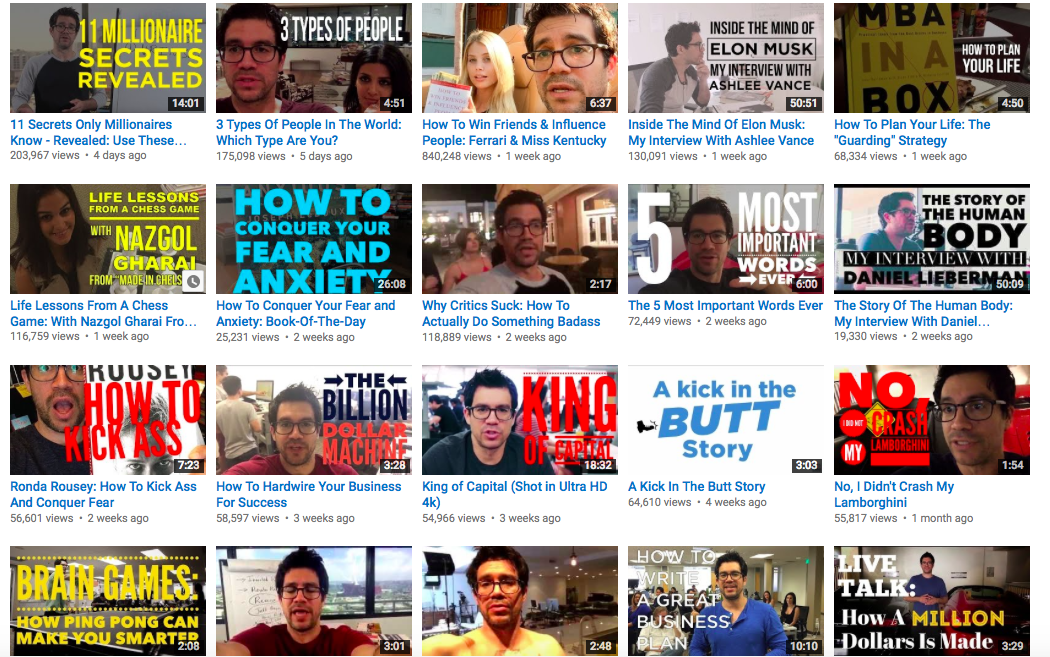
In these financially volatile times it's hard not to be tempted by this guy. Yes, he’s the one who incessantly edges in between you and that YouTube video you’re trying to watch, insisting he has the secret to wealth. And A Lamborghini. Plus a Ferrari. And don't forget the house in the Hollywood Hills.

So uniquely annoying is this finger pointing garage guy that we’ve all watched at least 10 seconds of his video, and if you were being totally honest you'd admit to having watched more. By the way, he has a name. It’s Tai Lopez. 

I must confess: At first I thought Tai Lopez was some kind of David Cross or Fred Armisen-like character, promoting an upcoming show on Netflix. Or maybe it was some sort of branded content play, sponsored by a company or product, that would reveal itself in subsequent pre-roll videos as I made my around YouTube. But no, it turns out we must take him at face value. This king of the not-at-all-humble-brag is this decade's version of the informercial pitchman.


Ah, yes, informercials, those magical faux-shows that are too long to be commercials and too pushy or biased to be actual TV shows. Their formula: to present a problem/solution combo, generally overstating the gravity of the problem, and then providing a miraculous fix, for 2 or 3 easy payments of a price that ended in .99.

It's a drill we all became familiar with starting in the mid 1980s, when the problem of 'dead air' on television was solved with a new entry in the TV Guide schedule grid: 'paid programming'. 

And so a new genre of advertising was born -- DRTV, or direct response television. The air time between 1 and 6 a.m, while less than optimal for reruns of sitcoms, movies, and talk shows, made for a great home for the marketers of  Snuggies, Chia Pets, and the like. Perfect purchases to consider when you've become one with your couch, your lids are becoming heavier, and dialing a 1-800 number seems like a not bad idea.
As Seen On TV:
Infomercial offerings brought into physical world malls

The radical idea of DRTV was that there was no middleman or retailer involved. Goods would flow directly from the manufacturer to the consumer, first via 1-800 numbers and then via websites. And then in a kind of negation of the initial concept of DRTV, physical retail was introduced with the "As Seen on TV" stores in malls.

But what does all of this have to do with that 'here in my garage' guy? 

Well, once again, the Internet completely shakes things up, and we can use the example of Tai Lopez to illustrate precisely how.

Whereas previously tens to hundreds of thousands were spent making infomercials that sang the praises of the blender to end all blenders, or dramatizations that illustrated how one's life would be improved by a blanket with sleeves, all a pitchman needs to do nowadays is rig his iPhone to a selfie stick. Production can be that basic. And on the Internet, less slick or formatted often beats polished and professional.

Additionally, there's no media buy involved this time around. That middle of the night time slot on your local television station in which you would broadcast your DRTV program cost thousands. Today, Tai Lopez just uploads his multiple hour path to riches videos directly to YouTube, and the cost to him? Nothing.

But how do people find these videos, in a world where hundreds of hours of videos are uploaded to YouTube every minute? The answer to this question is also why most of us know the guy in the garage pointing to his Lamborghini. It's the targeted pre-roll ad. Every time you watch something on YouTube, or use Google, or Gmail, or any of the other Google services, the system gets to know you better. It learns about things like your click history, your likes and dislikes, and your demographic profile -- and from a fusion of this data, specific ads are served to you. Based on the number of people who know his videos, and the number of times per day I see them, my hunch is that Tai Lopez has cast his net wide, not just at, e.g, 18-34 year old men, or urban-dwelling women who buy a lot of shoes online. Let's just say his media buy with Google/YouTube is substantial.

Tai Lopez energetically takes to YouTube
And people seem to be responding to this Tony Robbins of 2015. As of early September 2015 Tai Lopez  has 258,000 subscribers and 13 million views for the portfolio of videos he's posted to YouTube. You can watch those for free. Just like you can go to the iTunes store and download 100 of his podcasts for free. Big deal, you might say...he's good at giving things away for free.  But what he's really good at doing is saturating multiple platforms with content, and doing so at little cost to himself, for all those reasons described above. In the process Tai Lopez establishes his brand and -- are you sitting down -- basically creates infomercials for his informercials, and presumably makes some sales of his 'millionaire mentor' and 'mini MBA' programs along the way.

In parallel to the media horn of plenty for which the man himself is responsible, there's a world of Tai Lopez-themed content to be found online. He's discussed in detail on Reddit, where one commenter has given him the sobriquet of 'douchecanoe', and he's paid tribute to with memes and parodies, some of which merely poke fun at Lopez, some of which are in pretty bad taste, and others that reference other memes.


Though most of us are probably not going to end up as customers of Tai Lopez' make-a-million tutorials, if we take a few steps back there's much to be learned about the unique ability of the Internet to create value by way of the targeted, the interruptive, and even the off-putting.


The guys who would be Tai


December 2016 Update: 1.6 billion minutes of Lopez' videos have been watched online. How he did it, according to him (of course)