Tuesday, April 30, 2013

Better viewing through chaos

In the last post we looked at the coming of age of YouTube as an increasingly serious contender in online entertainment. Numbers so large that they are difficult to wrap our heads around: One billion unique users every month, over 4 billion videos streamed daily, over 6 billion hours of video viewed per month, and 100 hours of video uploaded per minute. In fact, YouTube viewing has become such a popular and mainstream pastime that JC Penney employees were tracked earlier this year and the results indicated that they had watched five million YouTube videos, from the office, over a period of four weeks. I raise this point because it's an example of the completely different context in which media and entertainment are now able to reside. Previously this thing called 'media' was something we experienced at home, or in our leisure time, on devices that were either tethered to rooms, or on Walkmans and Discmans (or even transistor radios, for people who go back that far...hello to you, if you do) that we wore while walking around, exercising, or on bus, train, and subway journeys. And it was something that came from locales of industry, generally hierarchical structures that let certain things past its gates, and kept others out, with the assumption that industry knew better than audience what the audience desired.

Model wearing early Walkman, 1980.   
As things shifted from the vaguely personalized, but still centralized, media model of, say, the Walkman days to today's anywhere/anytime/everywhere/all the time media, new ways of thinking about the production and consumption sequences and cycles become more important. The why people do what they do, along with the where, how, and under what circumstances, are immensely helpful in understanding new systems that at first blush seem to defy the logics we have used to guide us in the past. It is the desire of this blog to provide readers (and in the process the writer) with some insights into how we might better navigate this shift from fixed, filtered, and scheduled industrial-grade media to one where the experience of media is ubiquitous and self-serve and content is constantly in motion.

As we venture down that path we entertain such questions as:

Is niche content just for niche audiences?

- What happens when media content can be created by the individual and achieve free, global distribution, without the interference of gatekeepers?
 
- Will the result be something of interest to anyone outside of the person that posted it and his/her social circle? 

- Could an online platform designed without the elements of an organized system gain enough traction to take a bite out of the public's media consuming practices? 

- Are there forms of entertainment that a more freeform platform than traditional broadcasting can provide that could now find a 'big enough' (as opposed to mass media 'big') audience?

Earlier posts have looked at specific industries, such as music and film, and the new challenges that come as the pendulum swing toward digital. This series of posts looks at YouTube, the online video platform that spans multiple screens and moments, that breaks almost all of the rules created by the entertainment industry in the 20th century, as a framework for thinking about new channels of distribution and the new forms to which they give rise.

As is the case with so many startling statistics, the billions of this and that that we keep seeing pop up with regard to YouTube are, after all, just numbers. And numbers only mean something in the context of other numbers. So I whipped up a little compare and contrast table, using data from digital analytics firm comScore, to get a snapshot of how things have evolved in the online video marketplace over the past four and half years. (I picked this slice of time because I wanted to see the numbers before players such as Hulu and Vevo came into being, and  before Facebook enabled video embedding.)

And here's what we have:

Data compiled from comScore quarterly reports


Some takeaways at a glance:

  • Internet video went from essentially zero to 33 billion in a handful of years. 
  • The amount of online video has almost tripled in the 4+ year period being looked at here.  
  • Note: not included in the above table is the number of minutes spent on YouTube monthly, which is approximately 62 billion, spread across approximately 15.5 billion videos, for an average viewing duration of around 4 minutes. 
  • The plethora of small players and pirate sites make up almost half of online video viewing, but, nevertheless -- surprise surprise -- the world of online video is ruled by YouTube (or, since the late 2006 acquisition, Google, hence its appearance in the chart above under the umbrella of 'Google sites'). 

It's also interesting to observe that even in the wake of the arrival of the industry-sanctioned sites such as Vevo and Hulu, YouTube remains king. Everyone else, even Facebook, with its 1 billion+ users, and established online entities (e.g. Microsoft, AOL, Yahoo!) and offline entities (e.g. Turner, Viacom, ESPN, Disney) net only single digit share of online video viewing.

Although an average of 4 minutes of viewing does not make for a compelling comparison with television or even radio, the abundance and variety of video content now available online has created a group of new viewing experiences that don't fit within the rubric of television, but do speak to what segments of the audience definitely want.  While broadcasters and networks structures were/are skilled at making mass entertainment for mass audiences,YouTube is showing that it has great resonance with niches. And when I use the term 'niches' I don't only mean content for which there is a small or select audience, but also the things for which we didn't even have a category, such as five seconds of Dramatic Chipmunk (now closing in on 40 million views).


But it's not like these things are obvious, even to those in the higher echelons at YouTube. Just this week a YouTube executive admitted that even he had erred in his strategic thinking about what the service does best. "I thought YouTube was like TV", he said, "but it isn't." This after what the Wall Street Journal reported to be a $350 million investment in the original channels initiative during 2012 and 2013, the objective of which was to segment audiences, encourage longer viewing sessions, and to attract 'blue chip advertisers'.  Not at all Dramatic Chipmunk.

At its core YouTube is not like TV, and TV is not like YouTube, as much as industrial logic may want it to be. Just as radio listened to in your bedroom or your car is an entirely different experience from using Spotify or Pandora on your phone, tablet, laptop, or desktop computer. These inherent digital differences help explain why, e.g, when Craig Newmark started Craigslist in San Francisco in the late 1990s (resulting in the world's largest online classifieds service) only in theory could it have been the domain of newspapers. And so it is with online video and the established players in broadcasting, such as networks and cable companies. Only in the broadest sense are, e.g, NBC and YouTube operating in the same space. In both of these cases cases -- i.e. online video and online classifieds -- the reason not a lot of attention was paid to the up and comers is that no one in the big organizations thought there was a serious threat to their core businesses. The new spaces were looked upon as fraught with issues such as inferior selection/quality and therefore small market share, not to mention assorted legal considerations, the loss of control that comes with interactive platforms, and the challenges of monetization. Overall the risks seemed to outweigh the benefits and the media-entertainment complex continued on its way. Ed. Note: And in possibly the worst case of fumbled industry ball, there's the music labels losing out to iTunes, a milestone which we are celebrating the 10th anniversary of this week.)

Yes, hindsight is a privileged position from which to judge the past, but that's not my objective here. I think we're all better served by a closer look at why large organizations that ostensibly had the
opportunity to stake out new ways of doing business did not. We can all imagine the talk around the meeting room tables, where these topics were likely raised once, if not several times. These new options were 'too off focus', 'too uncontrollable', and in a phrase 'not what we do'. It was the chaos that the new systems brought with them, chaos that posed a threat to the existing structure, that was simply too big to contemplate. Which just goes to show, particularly in matters related to technology and media, we can't use the categories that we currently have to think about how things may look in the future.

And this is what disruptive innovation truly looks like. The story of things considered (if considered at all) to be small potatoes, if not waste of time exercises. Products or services that were more limited and inferior to those of the major players and then, over a period of time, the incumbents are overtaken by the newcomers. Things of which we would initially ask "why on earth would I ever do/use that?" and then, in time, a logic to the chaos starts peeking through and "why would I do that" becomes "why not"? -- Twitter being perhaps the most poignant example of this why-to-why-not shift. At the same time, if there's not a saying like 'the difference between crazy and feasible is a couple of years', perhaps there ought to be.

In 2009 Alan Kirby used the phrase haphazardness to describe an essential quality of YouTube. "...Rhetorically everything is up for grabs...in process, made up...as it goes along", (p. 119) , or as John Hartley (2011) put it, rife with "unsystematic exuberance and unambitious content" (p.107) , yet, as he himself admits just a few lines later, YouTube ushers in an important new era of productivity and representation.

Upcoming posts will consider these topics in greater detail. I'll look at YouTube as an open and wonderfully chaotic platform, from which things of great interest and value can be constructed, both within the inherent chaos and within some of the structures of order that have more recently been layered onto it. And the rest, the approximately 2/3 of videos uploaded that receive fewer than 1,000 views and cost far more in storage and streaming costs than they will ever bring in via advertising, well, they just peacefully co-exist.  Only in the digital world could this ever be the case.

June 2nd, 2013 update:

I just found this enlightening blog post from YouTuber Hank Green, a participant in the funded YouTube original channels initiative with the channel Crash Course that offers up 5 to 15 minute videos on topics ranging from world history to chemistry and literature.


Though grateful for the support received from Google & YouTube he has referred to the effort as a 300 million dollar hole. Though a few bona fide hits emerged from the project, over 2/3 of the channels were not renewed with additional funding. Hank's channel has an impressive 735,000 subscribers and 39 million views and despite the cash injection received he maintains that when it comes to online video "it's now how good it looks, it's how good it is".


Related Post: Podcasting: Art, Craft, or Reaching The Niches  

Thursday, April 18, 2013

YouTube: What happens when TV goes online


What happens when this thing we think of as television goes online? At the heart of this question is the very issue of the massification of media that grew out of the centralized, industrialized structures of the 20th century vs the demassification we're seeing in this century, with the extreme fragmentation of audiences, platforms, and content categories.

As this takes place -- and we are experiencing this shift in real time -- we have the opportunity to run some little experiments, which I will chronicle here in a series of blog posts. I want to tackle a few issues:

  • Look at the extent to which this thing we have become accustomed to as the electronically transmitted visual medium ceases to be television, enmeshed as it is with all sorts of industrial, commercial, and cultural considerations, when content and distribution shift to an online environment. 
  • Consider if this new platform, with its wild west, open to anyone ethos, threatens the omnipotence of television in any significant way.
  • Document the spillover of practices from online video to TV and from TV to online video.
It's all up for examination, so today on the blog, Part 1 in a currently open-ended series on ways to think about YouTube, the world's leading online video platform, that has been called everything from an "infinite gallery of...poor fools dancing, singing, eating, washing, or just staring into their computers" (Keen, 2008) to a new global media paradigm.


Young woman staring into computer, 2008.  6.7 million views as of 4/18/2013

Let's start with some basic binaries of the world of television, and its attendant systems, hierarchies, and strengths, and do a quick compare & contrast with the anything-goes world of YouTube.

At first glance you would think -- as most of us did when we first experienced YouTube -- that it had little chance of dethroning, or even affecting the course of  mainstream entertainment; mainstream entertainment being what it is as a result of decades of investment, talent cultivation, rigorous audience analysis, and marketing and promotion. Why some people would post to YouTube seemed a simple enough proposition, but why anyone would watch this unfiltered grab bag of home movie clips for more than the experience of a brief oddity was largely mysterious.

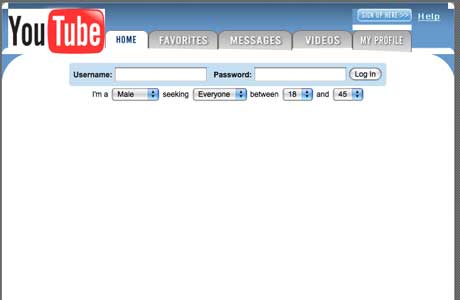
And even the founders of YouTube weren't sure what their platform was best for. In fact, in its earliest incarnation in Spring 2005 there were dating site elements on the home page as online dating was a big growth industry at the time, and one of the initial ideas was to use the online video repository as a way to meet people while on the web.


Fast forward to today, and scan some YouTube stats, as of Spring 2013:

  • 1 billion active visitors per month 
  • 72 hours of video uploaded per minute (up from 48 hours per minute in 2011, 24 hours in 2010, 14 hours in 2009, and 9 hours in 2007) *Note: As of May 20, 2013 the figure for hours uploaded per minute is 100.
  • Tens of millions of channels, started by everyday people.
  • Tens of thousands of of YouTube partners, i.e. content creators that meet the criteria to monetize their uploaded videos.
  • A few hundred YouTube Original Channels, an initiative launched in the fall of 2012 which showcased content creators from the worlds of music, comedy, sports, fashion, health & fitness, beauty, design, and assorted lifestyle channels, as well as channels carrying the names of well-known celebrities like Jay Z and Tony Hawk and lesser known performers like Smosh and Nerdist.A first round of $100 million was announced in October 2011 followed by a second round of investment of similar size in October 2012. More to come on the YouTube channel initiative in forthcoming blog posts.
So how did a website that wasn't even the first, or second, but the fifth entrant to universal video uploading (preceded by MetaCafe in July 2003, Vimeo in November 2004, Google Video in January 2005, and Daily Motion in March 2005) grow into the de facto video library of the world, one that would alter both our experience and definitions of visual entertainment?  The reasons for why one company succeeds while others flounder, or become also-rans, are many, but a pretty convincing discussion on this question can be found here.

But back to YouTube, and its extraordinary growth curve that brought it from single digits hours of video being uploaded per minute for its first 4 or so years of existence, to the first sea change, around 2009, when numbers jumped from uploads of 10 hours/minute to 25 hours/minute, 72 hours of video/minute by 2012, 100 hours/minute by the end of 2013 and almost certainly more by the time you're reading this. On the consumption side YouTube is at approximately 4 to 5 billion views per day.


And you could say -- and many have -- that this is a 'so what' statistic, that it only proves that because there are no costs associated with uploading video to YouTube there are no disincentives. When cost of entry is zero, why not enter? You can use YouTube to post videos of your kids and pets, you can use it to showcase your budding, or even middling talents as a singer, comedian, animator, makeup artist, etc. Does this then make it a digital dumping ground? The answer would be yes, but that in the case of YouTube it turns out not to be a bad thing, despite the high costs of storage, streaming, and keeping the site running.  These kind of economics would never pass muster in the world of mass media, which is all about carefully created content and carefully segmented audiences, but online, where shelf space is potentially infinite it can work.

Consider these numbers, though a few years old, but note that 63% of videos posted to YouTube receive fewer than 1,000 views, and just 1/3 of 1% receive over 1 million views. My hunch is that while there are now more videos achieving millions of views than in the early days of YouTube (as reported in an earlier post here), the prodigious volume of videos posted (72 hours per minute and growing) keeps the relative percentage of hit, or popular, videos quite low.

Source: http://articles.businessinsider.com/2009-05-20/tech/30027787_1_tubemogul-videos-viral-hits

And yet, while the YouTube curve of videos uploaded per minute and views per day grows exponentially, there's this data (from 2011, though the relative numbers have not changed a lot since then) which shows that for all its corralling of eyeballs, YouTube is still a bit player in the view catching sweepstakes.  For TV's 150 hours viewed per month (in the U.S.) YouTube gets just three.
From: http://www.businessinsider.com/chart-of-the-day-tv-online-video-2011-4

So why all the hubbub? And how could this possibly be working, working in the sense of efficiently providing audiences what they want to see, and working in the financial sense, as in how is this economically feasible?  Some of the answers, it turns out, lie in the counterintuitive.

See the next post in this series here.

But first: don't miss The Gregory Brothers' musical history of YouTube, on the occasion of its 8th anniversary, told in 3 mid-tempo minutes.


Related Posts: 

Podcasting: Art, Craft, or Reaching The Niches 
YouTube: When the going gets weird...YouTube goes mainstream?
The Stars of YouTube: Buffer Festival 2014
Platform Capitalism, or why your parents don't understand the Internet

Friday, April 5, 2013

Hollywood, the indies, and digital distribution

The last post looked at a number of the new intermediaries, or middlemen, that have emerged in the music industry as power shifts from -- and note, I'm not saying entirely away from -- but from a handful of big monolithic players and a small number outliers to fewer monoliths and scores of small-to-medium players. I believe there will always be a few big players, and that there will always be a need for big players as they understand and serve the mass market well, so let's put aside the whole 'we don't need the majors any more' discussion for now.


What the major labels are to the music industry the studio system is to the film industry. In the U.S. the film industry is about a $100 billion industry (see full spreadsheet here, courtesy of the hard-working folks at informationisbeautiful.net), and as such is considered one of the primary drivers of the country's economy.  When it comes to productions like Titantic, Shrek, and the Batman franchise, nobody does it better than Hollywood. Much has been written on the topic of the omnipotence of Hollywood already, so this post will instead shift its gaze toward how the independent end of film is faring in these digital times.

Disclosure: This is not an area of great personal expertise, but I am interested in looking at the supply/demand/democratizing issues seen in the context of the music industry, as they play out in the real of filmmaking. So I did some research, I canvassed some people that know the terrain better than I do, and the result is this post.  If I am woefully misinformed or just flat out wrong please leave your comments below and I'll revise the post accordingly.

For now you can read on for a consideration of questions such as these:

Are things now better or worse for independent filmmakers?
Does the fragmentation of audiences enabled by digital media and networks level the playing field for the indies in any meaningful way?
Or, in a business that tends to be about big budgets and bigger bets, are the indies no better off in these self-networked times than they were in the days when studios and cineplexes were crucial to any kind of success?

We'll start at the makers' end of things: Supply. There was a time when specialized skills, equipment, and large amounts of capital were required to make a movie. Filmmaking was one of those things that only the most ambitious, gifted, or privileged could even contemplate. Then along came digital. The advent of handycams and teach-yourself, often free, editing software meant that motion pictures cameras went from being something unusual to something more or less mundane. And so a glut was created at the on ramp that is production, where previously the barriers to entry had been insurmountably high. With a camera that cost maybe five hundred dollars you too could make moving pictures. Which is how we got things like America's Funniest Home Videos. But with a budget in the tens of thousands you could make actual films, things that could potentially make an impact (as Kevin Smith did with Clerks, as did the producers of The Blair Witch Project, SuperSize Me, etc.)  Compare these figures with averages of around $80 million for a Hollywood movie, plus marketing budgets of about $35 million.  And a hit rate of less than 1 in 10, with as many as 70% of major theatrical releases losing money, the next 10-20% maybe breaking even, and less than 10% turning a profit, according to Entertainment Industry Economics.

The freeing up of the field to anyone with an idea and the desire to execute it led to a flowering of independent film and video production. Filmmaking had been put into the hands of the people, at last. On the audience side new options flourished too. Cheap DVD rental and purchase, numerous legal streaming sites such as Netflix, peer-to-peer file sharing on pirate sites like Bit Torrent, full length uploads of films to sites such as YouTube, by both copyright holders and those who don't hold the copyright. Watching movies went from being an expensive, location-specific, heavily scheduled activity to an inexpensive, on-demand, anywhere, any time activity. The Economist reports that: "In 2011 American cinemas sold 1.28 billion tickets, the smallest number since 1995. [In 2012] ticket sales rose back to 1.36 billion and box office revenues to a record $10.8 billion, thanks to blockbusters like The Avengers. But film-going in America is not a growth business, especially now that people have so many media to distract them at home. The share of Americans who attend a cinema at least once a month declined from 30% in 2000 to 10% in 2011."

But what I want to know is if the shift away from the pay $12 for the ticket, $10 for the parking, and $5 for the popcorn movie experience might have a positive rebound effect for independent filmmakers. Because they can make their wares for less, and market them for less -- using digital and social channels -- and they can even bypass theatrical releases, in the process creating a new secondary, or possibly tertiary tier in the market. And for my own personal edification I wanted to find out if movies I loved, like Shut Up Little Man, (described as a documentary based on audio verite recordings of two raging alcoholics made by their Gen X neighbours) could now get made, be put out there, and find their audience through the magic of the amped-up word of mouth that is today's Internet and the availability of digital, on-demand entertainment.


I wrote to the team behind the movie and.... waited a few days. I didn't hear back. So I moved on with my investigation.

I next looked into what's involved in getting one's film onto something like Netflix or iTunes, through which anyone with an Internet connection or a $7.99/month subscription can access your 90 minutes of passion-fuelled artistry. Can anyone get onto, say, Netflix? Who, if anyone, is the gatekeeper in the system now that filmmaking is something more widely dispersed in the general population? What I found is that just as there are middlemen involved in getting your music onto iTunes there are also middlemen involved in getting your film onto sites like Netflix. The good news is there are far less hurdles and middlemen than before, when the last person to get paid, and the person who invariably got the smallest share of whatever the film made (if, in fact, it managed to turn a profit), was the filmmaker him or herself. The other piece of good news is that any time there are missing or not fully formed links in the chain, opportunity exists for someone to come up with a better solution, and in the digital space, it tends to happen with both frequency and speed.

As with my recent post on some of the new middlemen that comprise a music industry that is slowly reshaping, I am in no way endorsing any of the services mentioned in this post, just reporting on them, in an effort to map out the ways in which the film industry is reconfiguring to accommodate the influx of new, smaller-scale productions. There are numerous blog posts that address the question, some with the intention of selling you services, others that seem to be for informational purposes, and this one, that lays out what it takes to get your film onto Netflix or iTunes seems as good as any of them (just feel free to ignore the online filmmaking course they try to sell you at the end of the post).

The basics are:

You still need a distributor or aggregator, and here's why, according to the link above: "Distributors pick films that meet their creative and technical standards and films that they believe an audience will want to see...Retail platforms benefit from dealing with companies who have done their filtering for them and who have large catalogues of films and documentaries to choose from. This helps ensure places like iTunes and Netflix don’t become digital dumping grounds." Fair enough, as what qualifies as a film is pretty open to interpretation these digital days, and not everyone's home movie or high school project can be accommodated. (For that, and more, there's YouTube, the subject of upcoming posts, so fret not).

But back to indie film, and getting digital distribution.

So -- you need some sort of middleman, in the form of a distributor or aggregator, to act as at least a basic filter, not just for audiences but also for your 'retailer'. Also, if iTunes and Netflix were to deal directly with individual filmmakers with single projects it could quite quickly turn into an accounting and administrative nightmare. Therefore platforms prefer to deal with middlemen that represent a catalogue of productions and they can kill both the administrative and quality control bird with one stone. You do have the option of going straight to DVD, but again, in that scenario you will still fare better by involving a distributor. When the supply side is as heavy as it is now intermediaries can and often do help. Bear in mind that if you go straight to DVD or Netflix (vs. pursuing a theatrical release)  your project's value and earning power will be reduced.

iTunes recommends some of their more popular distributor/aggregators here, and others include Distribber. Incidentally, as of last year, Tunecore is out of film and video distribution, choosing to focus instead on music. If we use Distribber as an example the upfront costs are $1295 (SD) and $1595 (HD) and the chart found on the middle of this page breaks out the comparisons of this model vs. various revenue sharing arrangements.

Overall there are fewer middle men and, hopefully, less of the inscrutable, opaque accounting aka Hollywood accounting practices that specialize in taking tens or sometimes hundreds of millions of revenues and still managing to show a loss.  In this scenario the studio gets paid, usually quite handsomely, and anyone with points or percentages does not.  Ed. Note: And then there's this story, in which Donald Sutherland turned down a percentage deal for his role in Animal House and ended up forgoing millions.

What we've talked about thus far are the types of new intermediaries that exist for independent filmmakers, the people or companies that, ideally, help the producer find the biggest possible audience. But there are also some interesting non-market forces at work, the most notable of which is Kickstarter. Since launching as a crowdfunding platform in 2009 Kickstarter has raised over half a billion dollars in funding from close to 4 million people -- just everyday people, like you and me -- for approximately 40,000 projects. Project categories include art, food, fashion, music, film, theatre, comics, and design. Contributions to Kickstarter are considered donations, not investments, in the tradition of patrons of the arts of days gone by, and despite what rational economists might argue, the Kickstarter approach is working.

Film projects constitute about a quarter of all Kickstarter projects (25.8% as of 4/5/2013, which is where the stats below come from, and they're updated daily here), and represent 22.3% of all dollars raised by the platform.


In a talk given by Kickstarter co-founder Yancey Strickler this week at the MIT Media Lab, Strickler noted that more than 10% of films at this year's Sundance Film Festival received Kickstarter funding and that  more than 25% of films at this year's SXSW Film Festival were recipients of his platform's anonymous largesse. Furthermore, 63 Kickstarter-funded film projects received theatrical releases in 2012, six have been nominated for Academy Awards, and one even nabbed an Oscar this year, in the category of documentary short.  What all this suggests is that the crowd -- but not any crowd, this particular crowd, of ardent, discriminating film lovers -- is successfully creating a market where one previously did not exist, i.e. in the area of independent, often niche-interest films. Or as Yancey Strickler put it during his talk here earlier this week: "We have this sense that there's this one unified audience responding to things, but the Internet has a million niches and a million communities that care about various things...And we really know very very little about what works and what doesn't. We're still just guessing."

Wednesday, March 27, 2013

Meet the new middlemen...Part 1


As you can probably tell (if you've dropped by the blog before) I enjoy thinking about how new production and distribution models are taking shape in these ever-changing, highly digital times.  Let's briefly take stock: we've got free platforms with hundreds of millions of users, the ability to make high quality podcasts, songs, videos, and websites relatively quickly, cheaply, and easily. Global distribution happens with the upload of an audio, video, image, or text file.

Barriers to entry are now almost non-existent, so individual/independent writers, musicians, artists, and filmmakers, now have access to an international audience.  Unfathomable just a few short years ago. As the technologies and platforms become more user-friendly and plentiful, the floodgates open up, and everyone from the hopeful hobbyist to the professional has the same access. But now we have a logjam at the entry point to the market, because there are no content police standing there at the roadblock saying "excuse me ma'am/sir, can you pull over here so we can see your qualifications?" The price of entry is the doing. Period. And because this is the case, mere market entry brings with it less certainty than ever before.

What was once scarce, i.e. the ability to produce and the ability to distribute and/or publish those creations, is now abundant.

The digital era has changed a lot, indeed.  But...the idea that everything is now do-it-yourself, bypass the gatekeepers, go direct to fan, is somewhat overstated and oversimplified.  Yes, you can create and upload and share and use networks for large-scale, inexpensive distribution, and it's a fantastic and liberating thing which I'm all for.  But the likelihood of reaching a mass audience using solely these channels is slim. It can happen, but so can winning the lottery. The general rule, if there is one to be extracted from these musings, is that do-it-yourself and digital models are particularly valuable for niche products artists.  Using digital and social techniques and tools niche artists can find their audiences in a way, and on a scale, that previously did not exist. This means that niche no longer has to mean hobby, limited appeal, or money loser. In fact you could say there's never been a better time for niche. To this point note that the label with the biggest single slice of the music pie right now is not in fact a single label, but all the indies rolled up into one.  (Also note that Universal has since acquired EMI, and even with the sum of those two entities, the indies when considered as a single slice, are still larger. On the other side of this argument is that the 32% slice that the indies enjoy also counts indies that have major label ownership, either in whole or in part, but I won't be that much of a stickler for now. However you can be if you'd like to.)


Source: http://a2im.org/2013/01/07/indie-label-u-s-sales-market-share-grows-to-32-6-indies-remain-1-sales-sector/

What made many of the above points possible is the decentralization of power made possible by the Internet when it became a mainstream, consumer technology in the mid to late 1990s.  But for every force there is usually a prevailing counterforce and what we're seeing now are new intermediaries providing bridges that link, in the case of my area of interest, artists to audiences. This is not inherently a bad or good thing, but rather a way of understanding how marketplaces reshape as technologies change.

Time to meet some of the new middlemen. We'll start with the area of music and in later posts look at film and video. In music the biggest middleman is, of course, Apple, whose iTunes store launched ten years ago in April 2003, and which went on to account for close to 2/3 of all digital music sales. (The other third is split between vendors such as Amazon, Google Play, and CD Baby). What started out (arguably) with the objective of being a marketing platform for its iPod line of hardware has become a retailing juggernaut for not just music but books, games, apps, TV shows, and movies.  A full breakdown of the iTunes economy can be found here, but the condensed version of the story is large volume of sales, they take a cut of approximately 30%, and their profits have been estimated to be in the range of $2 billion for 2012. Whether they're better or worse than the labels is debatable. And I'm told that iTunes does not generally deal with independent artists. They require a middleman of some sort -- either a label (indie, major, it doesn't matter) or a distribution company...even though the product is digital. For rough comparison purposes the chart below, sourced here, compares the revenue splits for music on a variety of digital and physical platforms.


Software services that cater to the direct-to-fan, or D2F, market are many, and I'll use the rest of this post to introduce you to some of the more interesting and popular ones.  And note that I'm not endorsing any of them, but merely reporting on them. If you have an interest in using some of the services listed here I would recommend doing the usual due diligence by talking to others who use them or have used them, search around online for reviews, etc.  The basic point I'm trying to make is that many of the functions that were formerly the domain of agents, managers, and labels can now be accomplished with software.  And that direct to fan isn't exactly direct, but certainly is direct-er.

In the area of online marketing, merchandising, & fan communication some of the best known platforms are: TopspinTunecoreNimbit, and Fanbridge. Generally speaking these platforms make it possible for artists to handle a sizable chunk of the activities that had previously been the sole domain of managers, agents, and labels.  Email and newsletter blasts, social media dashboards, eCommerce for websites for the sale of band merchandise and concert tickets, and of course digital and physical sales of music.

If you want to book shows in people's living rooms there are sites for doing that. If you want to remove promoters from the picture there are sites like (the very cleverly named) Detour that let fans put their money where their concert wish is, thus reducing the risk to the promoter, and when enough dollars are in the kitty, the band comes to play in your town. If the show doesn't happen, you don't get charged. There are also companies that enable artists to work around the centralized ticketing systems of titans like Ticketmaster and LiveNation. For example there's GigSwiz, which bills itself as the "effortless ticket promotion tool for artists" and there are also services such as Tunezy and HugeFan that act as brokers between fans and artists, particularly in the area of enabling special fan experiences like dinner at home with your favorite indie band, or how about a custom song composition from them, or maybe a bowling party?  Those using the Bandpage platform will know that $2500 gets you a personal 30-minute guitar lesson, over Skype, with Ozzy's axe-man Zakk Wylde, or some of the more affordable indulgences below.

To me the overarching point is that rather than the industry being one giant monolith, a parallel system emerges, one made of many little pieces. Artists can cherry pick the pieces they want to use, and usually with little or no up front cost, and pay via revenue sharing as sales occur. This specifically digital business model is an attractive option for independent and/or niche artists as the incremental cost of doing business online -- compared to the world of physical objects for sale, warehouses, sales teams, print marketing, etc. -- is close to nil and like they say in those big box ads, the savings can be passed on to you.


Part 2: Meet the new middlemen in the world of filmmaking and independent and/or digital distribution here.


Related posts:

The economy of 'big enough'
Reintermediation Watch: The Tale of the YouTube Multi-channel Networks
Podcasting: Art, craft, or reaching the niches
...So you want to self-publish
The Creative Economy: Is the (3rd) Party Over?


Sunday, March 24, 2013

Let's do some simple addition: aka How much did Macklemore make?


Note: Apologies if there are font jumps later in this post; am experiencing some formatting problems and will try to resolve asap.

Today we're going to look at traditional music industry economics vs new music industry economics, using Macklemore, the subject of the last string of posts, as our case study.  I won't commit to a hard and fast definition of new music industry economics just yet, because I'm not only referring to the world of digital vs physical music, or the world of independent vs major label artists, or the world in which artists can go direct-to-fan and fans can communicate directly with the artist, as well as with each other.

Things are not that black and white, as we began to see in the previous post about Seattle rapper Macklemore. An unsigned artist, Macklemore rose to #1 on the charts around the world, sold millions on iTunes, generated close to 200 million YouTube views (as of late March 2013) for a single song, and/but did so with a combination of independent and industry resourcesAs we'll see, there are still intermediaries, just different ones, and under different deal terms. Will the post-industrial music business look that different from the industrial music business?  Come along for the ride and let's decide together.

But first, a few bases for our discussion. Major labels have long been vilified. Their processes have been said to lack transparency (there's that word again), their economics are said to resemble those of sweatshops, their royalty statements have been referred to as "works of fiction". Yet, the fact of the matter is that the major labels have been operating as investors in products that fail about 97% of the time. The money for recording, manufacturing, distribution, promotion, marketing, and sometimes touring is put out up front by the label, in the hopes that there will be a hit down the road. Preferably quite soon down the road. The labels work with a model of advances, i.e. the funds are doled out by the label to cover the costs listed above and then if/when the earn back happens, it is deducted from the advance.  Most major label artists only get a few albums with which to prove themselves, and most don't recoup, or pay back the advance or the charge backs to them. While it's easy to condemn this business model, it's one in which the odds are stacked against everyone. It's the ultimate high rollers game. The only reason it works/has worked, even with ridiculously low hit to non-hit ratio, is because the 3% that do become hits have become such colossal hits that they are able to carry the other 97% of the roster. Such are the economics of hit-driven businesses; movie studios and network television work with similar ratios. Just last week I heard a former president of one of the major studios speak and during his talk he shared his opinion of the industry's wildly unpredictable economics: "The movie business is a terrible business. It shouldn't even exist."

Despite all the disintermediation, or removal of middlemen, brought about in these days networked, digital systems, there are a few things that are the same in the old and the new. I'll do a quick review of them here, before doing some guesstimates of how the actual numbers look in Macklemore's case, just because it's been the object of study for the last several blog posts. Feel free to grab a pencil and paper as we go through the basic accounting and categories.


Royalty rates: These can vary from fractions of pennies for digital streaming to tens to hundreds of thousands and up to millions for use in advertising campaigns. Back in the good old days artists were able to command  multiple millions for the use of their song in a TV ad, as was the case when Microsoft wanted to use the Rolling Stones' Start Me Up in the Windows '95 ads. But back to digital royalties, the source of much consternation among artists today. It's another one of those 'it's the good news and it's the bad news stories'. The good news is that the radio programmer gatekeepers and the MTV-type programmers have been removed from the process. As an artist you can upload your music, you can make it available to streaming and on-demand sites. As a user you can click on songs and stations and playlists with Spotify, Pandora, Slacker, Rdio, Rhapsody, and others whenever you like. You can help yourself to all the streaming music you want, and if you don't mind listening to a few ads, you can do so for free. The bad news is that this adds to audience fragmentation and demassification. Where the mass media delivered mass audiences, digital media is able to deliver niche audiences. Consequently, the royalty rates are tiny. It has been reported that 70,000 plays on Spotify net approximately $300 to the artist. And what's more, none of these services has achieved profitability. Not yet, anyway.  In fact, it has been estimated that if traditional terrestrial radio had to pay the same royalty rate as services like Pandora they (radio) they would incur an additional 2 billion dollars in annual costs, which would most likely make their business model unfeasible. Because the numbers for digital royalties of this kind are so small, we won't even include them as a line item on the revenue side for the calculations below. They'll just be thrown in when numbers are rounded up.

On to revenues from the sale of recorded music. In the traditional music business model, in which the label signed the artist, and in which the artist failed to break even about 97% of the time, the pie was generally divided as follows:

Source: http://www.theroot.com/views/how-much-do-you-musicians-really-make?GT1=38002


Note that not all deals have the label taking 63%, sometimes it's closer to 50%, and a lot depends on the bargaining power of the artist (new artists have less, established artists have more). But as the above pies illustrate there's a whole lot of slicing that has to go on. So what if we removed the entity taking the biggest slice, i.e. the label, from the plate? Now, pencils in hand, let's make some sort of kind of educated guesses as to how this might look in the case of an unsigned artist like Macklemore, now with a huge international hit on his hands. I've tried to make none of these figures wild guesses, and have run numbers that I'm guesstimating past some folks in the industry.  So no guarantees that the numbers are accurate, just that they're not completely ludicrous.

iTunes: The Thrift Shop single has now sold approximately 5 million copies. Not only on iTunes, but also on Google Play and Amazon and probably via other smaller vendors too. But the vast majority of sales would have happened on iTunes. In the label world, if the download was priced at $1.29 the monies would be split this way:

Source: http://www.rollingstone.com/music/news/the-new-economics-of-the-music-industry-20111025

With no label in Macklemore's scenario the $0.60 is not taken off the top. But, as we learned in the previous post there is a distribution company involved, ADA, as well as some label services via ADA's parent company, Warner Music. According to manager Zach Quillen these services are paid for out of pocket, as opposed to with an advance, but we don't know if there's a percentage take involved as well. Just to be safe, let's say 20% to ADA and Warner. So, from that $1.29, let's say 40 cents to Apple, 20 cents to ADA/Warner, and the rest to recording artist and songwriter. In a way Apple (or whoever the digital vendor is) becomes the label in this scenario, taking 30% off the top; but in this scenario with no investment or risk in the artist. And while selling a digital product, with no incremental cost per unit, no manufacturing, shipping, or warehousing required. Meet the new boss, worse than the old boss?  (See this post for estimates of Apple's margins on iTunes and software sales.) Nonetheless, Macklemore & Ryan Lewis keep about 69 cents of every $1.29 sale. 5 million paid downloads @ $0.69 each = $3.45 million.

On to the album, The Heist, which has sold close to 500,000 copies in the U.S. and Canada as of late March 2013. I haven't been able to find a number for global sales, but let's throw in another 200,000 for a total of 700,000. The math here gets a bit conjectural as the digital album The Heist comes in two packages -- a deluxe version for $11.99 and the regular version for $9.99. Note the role of Amazon's discounting of the album to $1.99, which resulted in swift early sales figures. (This is a strategy Amazon has experimented with before, most notably with Lady Gaga's album in 2011. Demand was so high that their servers ended up freezing). To expedite the math let's just say $10 for the digital album, with a similar breakdown as for the digital single. Of the $10 we'll assume $3 goes to the digital retailer (iTunes, Google Play, Amazon, etc), and another $2 goes to the distributor ADA, which leaves $5. Therefore if we are assuming the sale of 700,000 copies worldwide = $3.5 million. So we're up to around $7 million, net to the artists, from the sale of physical and digital albums and singles.

Next up, YouTube, where the Thrift Shop video has 185 million+ views of today, and the Macklemore & Ryan Lewis channel has approximately 260 million views in total.


In other words Thrift Shop accounts for about 70% of the views on the channel. But, not all videos on the channel have been monetized. In fact Macklemore didn't start doing so for the big hit single until Thrift Shop hit 90 million views. So that brings the total of 260 million views down to 170 million views. And not all of the videos on the channel are monetized and not all views are as valuable as others. So let's take 100 million of those views as monetized and use a CPM (cost per thousand) of $5 (which seems fair, compared to the $8 CPM received by Gangnam Style). Continuing to pencil this out, we add another $500,000 of revenue from Macklemore's YouTube channel, bringing our running total up to about $7.5 million. 

Our next line item is touring. In Macklemore's case it looks like he and his crew have been doing several shows per week, often headlining at venues with a capacity of 4-5,000 as well as appearing on multiple band bills at festivals.

If we take an upcoming show at Sioux Falls, South Dakota's Elmen Center as an example, we have a venue with a capacity of 4,000, which seems to be in line with the size of venue he generally plays at, and let's assume a ticket price of $28-32. So, since the release of the album The Heist, approximately 6 months ago, let's say there have been 100 shows, with audiences that started out in the hundreds and increased to the thousands, with ticket prices starting at $12 - $15 and going up from there accordingly. 100 shows, with an average price of let's say $20, playing to an average of 1500- 2,000 people = gross revenues of $3 - 4 million for the past year. And out of this come the cuts taken by promoter, booking agent, and ticket agency, along withhotel rooms for band members and crew, flights and/or buses, meals, roadies, and per diems while on tour. Because it's difficult to estimate the below the line, or operating costs, I'm just going to assume an average to the band of $10 net per ticket x 1500 people x 100 shows, for a total of $1.5 million for touring for the past year after expenses have been paid.

One part of the Macklemore operation that is particularly profitable is the merchandise arm. This is the sale of t-shirts, hoodies, and assorted trinkets bearing the band name, that takes place at shows on the tour as well as on the macklemore.com website. The margins are generally high, meaning if a fan buys a CD and a t-shirt at a show, for a total of, say, $35, it's reasonable to assume that about $20 of that is profit. So while touring at this level may be modestly profitable, it's the sale of merchandise that helps offset the laundry list of costs detailed above. As a guideline, those in the merchandise industry suggest that 1-3% of concertgoers at the large arena venues purchase band merchandise, and at smaller venues not more than 7%. So let's take a conservative 3% of the average of 1500 people we assume have attended a Macklemore concert over the past year, and let's say that on average they spent $35 on merchandise. 3% of 1500 - 45 people. 45 people spending $35 each = $1350 per night. $1350 x 100 shows = $135,000 of which we'll assume close to half, or $70,000, is profit.


There are other revenues coming in, from activities such as songs licensed to ads, such as the one below, for a Miller Genuine Draft commercial in 2012, another for Microsoft's Outlook.com, and  a promotional ad for the NBA's All-Star Week in February 2013. Let's pencil these in at $50,000 each, for a total of $150,000 of revenue.


But remember, in the absence of a label the artists are financing everything themselves. Recording, manufacturing, design and production, distribution, marketing, promotion, producing and maintaining their website, producing and selling the merchandise, and don't forget there are also professional services required by the likes of accountants and lawyers.

After all these partially informed calculations I'm going to say that Team Macklemore -- the core group of Macklemore, Ryan Lewis, Manager Zach Quillen and Tricia Davis, has probably netted between $8 and $10 million in the past 6 or so months.  Although the numbers taken into account in this post add up to around $8 million I'm factoring in some margin for error, and to account for any overlooked revenue streams. Because we don't know exactly how they split the cash among the core team, I'm going to say that Macklemore himself has netted around $4 million since Thrift Shop has taken off.  For want of a better reality check we can use this estimate as one data point for testing our math. The author assumes $2 million net worth for Macklemore himself. This is when Thrift Shop was at 66 million views (it is now at 3x that level) and album sales were at 272,000 (it's now at 1.5x that level). Twice that level now seems reasonable.

Had Macklemore been on a major label the math would have looked something like the following:

Label advance of $500,000 to $1 million

First 50-60% of revenues go to label

Next 25% of revenues go to distributor

Charge backs for video production, marketing materials, promotional services, and miscellaneous fees such as breakage, container fee, etc.

If the deal was a 360 deal, in which the artist and label share revenues not just from the sales of physical and digital product, but also touring, merchandising, licensing, etc., the percentages would continue to be split. Much depends on the terms of the particular deals, and as this cautionary tale lays out, situations do exist where the artist sells a million albums, and still owes the label half a million dollars. This doesn't always happen, but it can happen.

So -- if we can draw some reasonable conclusions here, under a regular label contract, approximately 50%, or $4-5 million, would have gone to the label.

Under a 360 deal, which some labels now require artists to sign, the percentages would have extended to the revenues from concert ticket sales, merchandise sales, and song licensing from ads, so let's say a 50% cut of the $135,000 from merchandise, the $100,000 from licensing, and presumably a cut of the $3 million gross from touring, all of which adds up to an additional $1-1.5 million on top of the $4-5 million.

And still, some questions loom: Had Macklemore been signed to a major label from the outset would the sales have been higher? Would today's 5 million paid downloads of the single be 10 or 20 million? Rather than take four months to get to the top of the charts could Thrift Shop have hit the jackpot earlier, and enjoyed the higher chart position and higher sales for a longer period?

I guess we'll never know, but can think of it this way: the label would have needed to double the sales level for Macklemore to have benefitted at the same monetary level he has. Inversely, had Macklemore sold half as many singles, t-shirts, and concert tickets on his own, he may have fared better under a major label deal, in that the label would have put in more than he brought in, but that would probably ultimately have led to getting dropped by the label, which is how the major label model works, and I think has to work when the odds of success are so crushingly low.

As an indie (or more accurately 'indie plus', in which the artist is not signed to a label but instead buys, a la carte, major label services as s/he desires) the cash flow is as estimated above. Bear in mind, however, that the Macklemore scenario was only possible because of the leverage he possessed after close to ten years of building audience, building fan relationships, paying out of pocket for goods and services the label otherwise would have subsidized, and, of course, the wearing of many, many hats.  Is this a new model for the music industry? Perhaps.  In this pretty much ideal scenario we have the much desired win-win. A win for the artist, still able to call his own shots and guide his own career path, and a win for the label, who didn't have to risk capital up front on an unproven act.

Doing things the Team Macklemore way is a new way of operating both within and without the music industry, and requires rolls of the dice and sets of skills that not all artists currently possess, but may have to as the industry unravels, and then in time re-ravels.

Your thoughts and comments are welcome below; as are polite indictments of the assumptions or math in this post.

The next post in this series, on the new faces of the middlemen in the music industry, can be found here.